Drymobius margaritiferus – Breeding Report
Nicaragua Line (2025–2026)
Care Information
Drymobius margaritiferus (Schlegel, 1837)
Care & Breeding of a Documented Nicaragua Line
Introduction
Drymobius margaritiferus is a medium-sized, diurnal colubrid snake native to Central America. Its range extends from southern Mexico through Belize, Guatemala, Honduras, El Salvador, Nicaragua and Costa Rica to Panama, as well as parts of northern Colombia.
Although the species is not considered rare in its natural range, it is very rarely kept in terrariums and even more rarely bred successfully. Accordingly, available husbandry reports and practical experience are limited.
Since only a few publications on the keeping and breeding of this species are available, this account is based primarily on my own long-term observations of a documented breeding line from Nicaragua. All the experiences described relate exclusively to my own husbandry and are intended to serve as a guide for other keepers caring for and breeding this exceptional species.
My breeding line
Origin of the animals: Nicaragua
Acquisition of the first animals: 15.03.2023
Establishing the Breeding Group: March 2023 – September 2025
Current stock: 2.2
First successful captive breeding: March 2026
The aim of my project is to preserve a healthy, genetically traceable breeding line over the long term and to document biological, behavioural and reproductive observations as fully as possible.
Terrarium
The adults are kept in PVC terrariums measuring 90 × 40 × 60 cm.
The enclosure contains:
- Cork tubes
- Cork bark
- several hiding places
- individual climbing branches
- a water bowl
- natural forest soil
Although Drymobius margaritiferus can climb with ease, my observations suggest that it is primarily a terrestrial species. The snakes occasionally use elevated branches, but spend most of their time on the ground or in shelters close to it.
Equipment
Terrarium: PVC enclosure (ProCages), 90 × 40 × 60 cm
Beleuchtung: 12 Stunden täglich
UV lighting: T5 UVA/UVB lighting, 24 W
Heating: heat panel
Thermostat: Biotherm
Misting system: Once or twice daily for 45–60 seconds, depending on the season
Belüftung: Zwei Mini-Ventilatoren zur Luftzirkulation
Substrate: forest soil
Climate
The following climate parameters have proven effective in my care:
- Daytime temperature: 28–30 °C
- Nighttime temperature: 21–23 °C
- Humidity: 60–80 %
- daily misting
- very good ventilation
Humidity rises significantly immediately after misting and then drops again thanks to good ventilation.
Maintaining high humidity levels consistently has not worked well in my experience. Although brief periods of high humidity are well tolerated, a permanently damp environment caused skin problems in some animals. I therefore make sure the enclosure can dry out completely between misting sessions.
Behavior
Drymobius margaritiferus is an exceptionally alert and nervous snake species.
Contrary to the common assumption that this is a constantly active species that is easy to observe, my animals are extremely secretive. Except during feeding or the breeding season, they can often go for days without being seen. They spend most of the day in their hiding places.
However, as soon as someone approaches the terrarium, their behaviour changes abruptly. The animals register every movement outside the terrarium.
Their pronounced defensive behavior is particularly striking. While many colubrids initially flee, some individuals are remarkably aggressive. They lunge forward at high speed and make repeated attempts to bite rather than retreating immediately.
This behaviour should be taken into account, particularly when opening the terrarium.
Diet
There is currently little reliable information about the diet of wild individuals. Their diet is described as consisting mainly of amphibians and various lizard species.
Hatchlings
The captive-bred young are initially raised exclusively on mourning geckos (Lepidodactylus lugubris).
Accepted payment methods:
- live geckos
- freshly killed geckos
- occasionally small live frogs
Other food items have not yet been reliably accepted.
Subadults and adults
The diet changes significantly as they get older.
All semi-adult and adult animals bred by me readily accept suitable rodents. As a result, keeping adult animals is considerably more straightforward than raising juveniles.
Breeding
After a slight seasonal cooling, the animals reliably begin mating.
Start of the breeding season: My animals’ main breeding season begins in November. However, males have also been observed attempting to mate during the summer months.
A healthy female can produce several clutches in a single year.
In my care, clutches usually consist of 2 to 6 eggs.
Incubation
Incubation substrate: eggs on perlite or on a mesh grid over perlite
Incubation temperature: 28.0–28.5 °C
Hatching period: 48–58 days
Most of the juveniles in my breeding program hatched around day 52 of incubation.
Even temperature differences of around one degree significantly prolonged the incubation period.
Read on below for detailed information.
Rearing
The hatchlings weigh approximately 3.5 to 5.7 g.
After their first shed, they usually start eating geckos on their own without any problems.
For raising juveniles, I use small, well-structured terrariums (e.g. Exo Terra 30 × 30 × 30 cm) with good ventilation and several hiding places.
My observations
Over the course of my breeding project, I was able to make the following observations:
- The species is predominantly terrestrial.
- Elevated perches are used only occasionally.
- The animals spend most of their time hidden.
- Outside the breeding and feeding periods, they are often not visible for several days at a time.
- Even movement outside the enclosure is quickly noticed.
- Some animals show pronounced defensive behaviour and actively attempt to bite.
- Persistently high humidity can contribute to skin problems.
- Hatchlings initially need lizards as food.
- Subadult and adult animals readily accept appropriately sized rodents.
- Healthy females can produce several clutches per year.
- Incubation at around 28.5 °C produced the most reliable results in my breeding program.
Breeding Project Timeline
Year
Event
2023
Acquiring the first animals
2025
Breeding group established
2026
First successful breeding
Personal conclusion
Drymobius margaritiferus is one of the most interesting Central American colubrids for me. Despite its rarity in the terrarium hobby, this species can be kept successfully and bred regularly under suitable husbandry conditions.
Many of the observations described here differ from the few published accounts and are based solely on my own experience keeping a documented Nicaragua breeding line. I hope this report helps expand our knowledge of this fascinating species and provides other keepers with practical guidance for its successful care and breeding.
Breeding Plans 2025–2026
The following conditions were planned for the first breeding season:
- Possible pairing: 05.10.2025
- expected egg laying: 11.01.2026 (planned)
The animals already showed consistent food intake and normal activity levels during this phase.
Breeding Progress 2026 – Clutch 1
The pre-laying shed was observed on January 6–7.
Feeding remained consistent throughout until shortly before egg laying.
The day before laying her eggs, the female showed markedly increased restlessness, as well as aggressive and searching behaviour.
Egg laying (Clutch 1)
Oviposition began early in the morning, at around 5:00 a.m.
The first egg was removed at approximately 6:30 a.m.
Clutch data
- Number of eggs: 3
- Status: 1 egg fertilized, 2 eggs presumably unfertilized
- Consistency: one normal egg, two soft/slimy
- Development: only one egg developed fully
Incubation & Hatching (Clutch 1)
- The fertilized egg was incubated at 28.5 °C.
- From day 49: visible loss of volume
- Hatching: Day 51
Juvenile
- Weight: 5.7 g
- Development: successful hatching, complete development of one juvenile
Breeding Progress 2026 – Further Reproductive Cycles
Clutch 2
A further mating phase (PLS) was documented on March 19, 2026.
On the same day, from around 10:30 a.m., the female showed calm, partially concealed behaviour in the laying area.
⸻
Egg laying (Clutch 2)
- Number of eggs: 6
- Fertilization: all eggs fertilized
- Notable feature: highly variable egg sizes
Egg laying was calm and there was no attempt to escape.
Unlike her usual behavior, the female was unusually calm while laying her eggs.
⸻
Development & Hatching
- Incubation period: approx. 51–52 days
- Hatch date: 09.05.2026
- Hatching success: 5 of 6 hatchlings
Even the smallest eggs developed fully and hatched successfully.
Hatchlings
- Weight: approx. 2 g
- Feeding: self-feeding (small geckos)
- Course: increasing losses after 5–6 weeks
⸻
Egg Dimensions (Clutch 2)
- Egg 1: 7,57 g – 41,88 × 16,88 mm
- Egg 2: 6.78 g – 37.14 × 17.00 mm
- Egg 3: 7.64 g – 42.84 mm (Ø 16.65 mm)
- Egg 4: 4.89 g – 29.54 mm (Ø 16.88 mm)
- Egg 5: 3.15 g – 22.35 mm (Ø 15.02 mm)
- Egg 6: 2.93 g – 22.35 mm (Ø 15.15 mm)
Clutch 3
Mating took place on the evening of 23.04.2026.
On the morning of April 24, the female was restless again and actively searching for a suitable place to lay.
Egg-laying began at around 08:30 and lasted approximately 2.5–3 hours.
The female remained remarkably calm throughout the entire process.
⸻
Clutch data
- Number of eggs: 5
- Total weight: 38.2 g
- Individual weight: approx. 8 g
- Size: approx. 36 × 16 mm
⸻
Hatching
- First hatchlings: 10.06.2026 (Day 48)
- Main hatching: 13–14 June 2026
All the hatchlings emerged within a short period.
Young animals (weight)
- 4.9 g
- 4.8 g
- 4.62 g
- 4.98 g
- 5.22 g
Clutch 4
The fourth clutch was laid on 27 May 2026, about 33 days after the previous clutch.
The same laying site was used again.
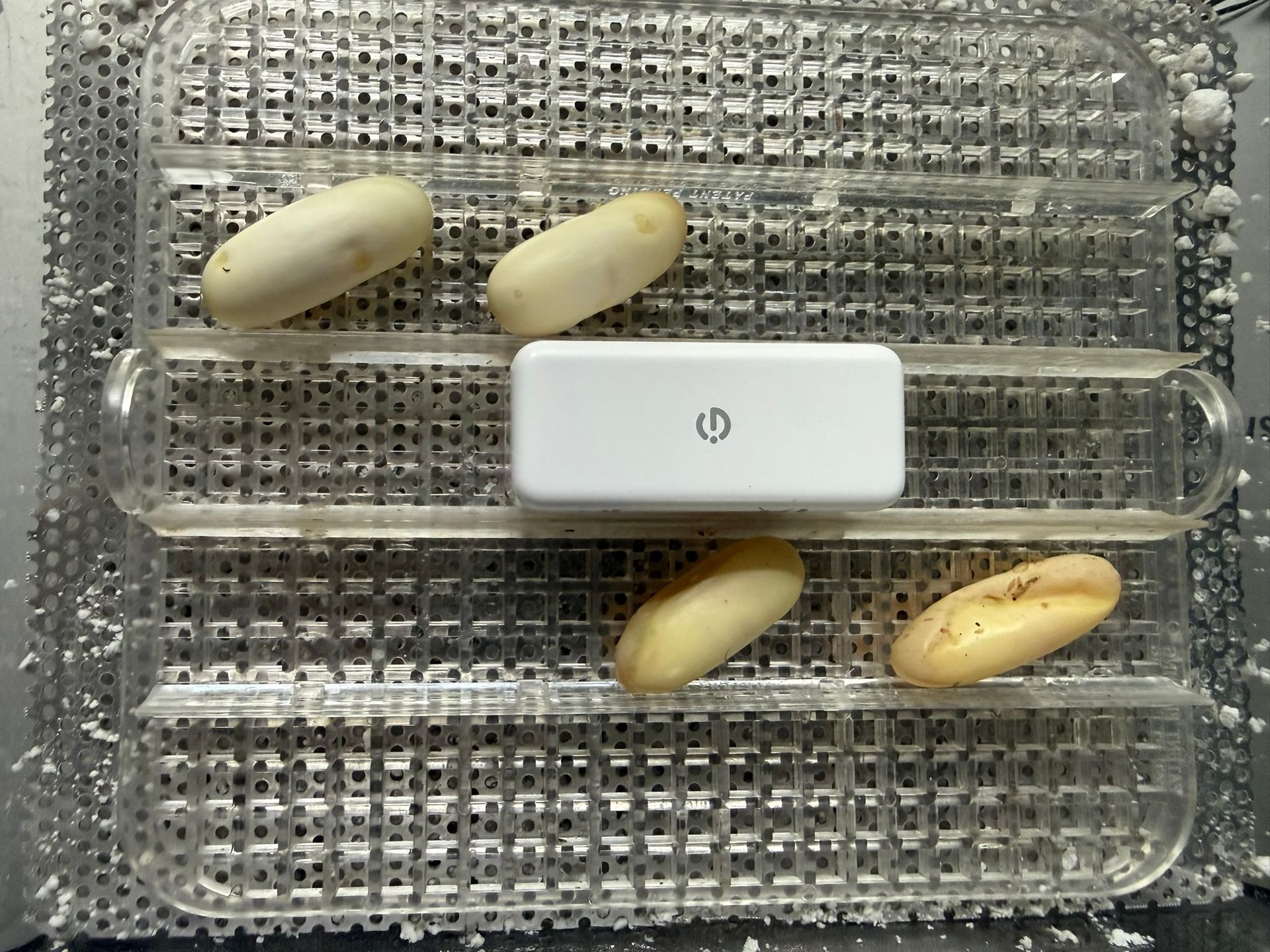
Two eggs showed yellowish discoloration and a slight net-like pattern, suggesting they may have been infertile.
⸻
Incubation
- Initial temperature: 28 °C
- Later stage: 26.5–27 °C (separated eggs)
- Average 27.5 °C
Completion of Incubation
After about three weeks, the two infertile eggs were removed from the incubator.
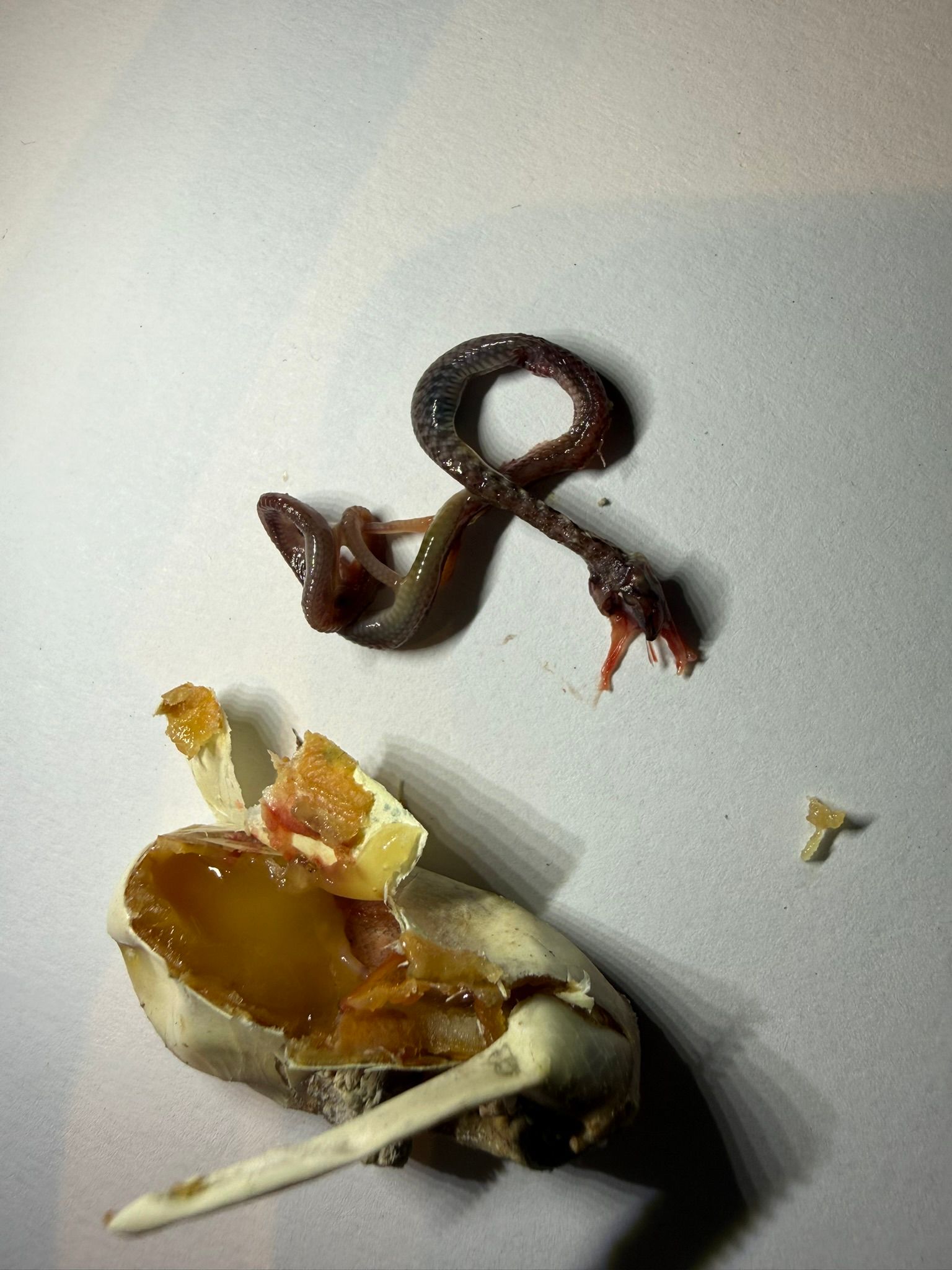
The two remaining eggs began to lose significant volume about two weeks before the expected hatching date. At the same time, one of the eggs showed signs of mould and felt unusually hard. When I opened it, I found a partially developed hatchling inside. Judging by its stage of development, I believe it had died one to two weeks earlier.
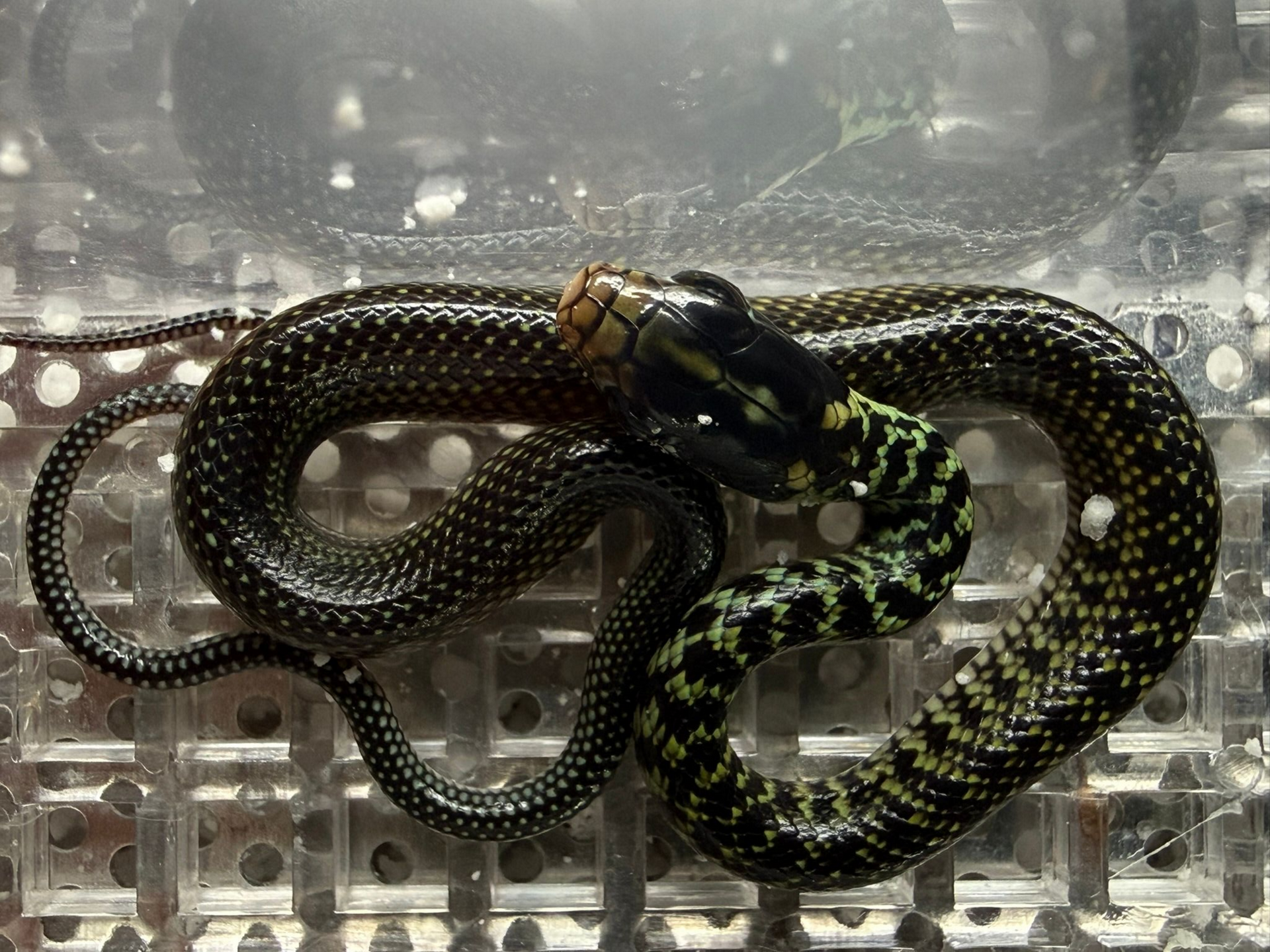
The last hatchling finally emerged on 22.07.2026 after an incubation period of 58 days. Compared with my previous clutches, an incubation temperature around 1 °C lower extended the development time by approximately six days.
With a hatch weight of 3.46 g this hatchling is one of the smallest produced this season. The coming weeks will reveal how it develops. Based on my observations so far, however, I continue to favour incubation temperatures of 28.5 °C and above, as the third clutch produced the most vigorous and, overall, highest-quality hatchlings under these conditions.
Care Information
Rearing
The juveniles are very shy, but display typical behavior for the species.
They are active, but retreat immediately as soon as the terrarium is entered.
⸻
Rearing Conditions
- Terrarium size: Exo Terra 30 × 30 cm
- Klima: wie adulte Tiere, leicht angepasst
- Setup: structurally rich, with plenty of hiding places
⸻
Feeding
Preferred food during the first few weeks:
- small geckos (offered live or dead)
Not accepted during the first 4–7 weeks:
- Insects
- Fish
- Chicken heart
- Mice
- Pieces of frog
⸻
Development
- first shed: 7–12 days after hatching
- approximately every 30 days thereafter
- First feeding: immediately after the first shed
⸻
Additional observation (2025)
A CB juvenile from Poland (Hamm) showed an extreme stress response during routine care (substrate change) and subsequently died.
This highlights how susceptible juveniles of this species are to stress.
There are also reports of possible tail-autotomy-like responses, similar to those seen in geckos. I have not observed this myself so far.
⸻
Conclusion:
The species has a high reproductive rate, but the development of young can be sensitive, and hatching and rearing outcomes are highly variable.