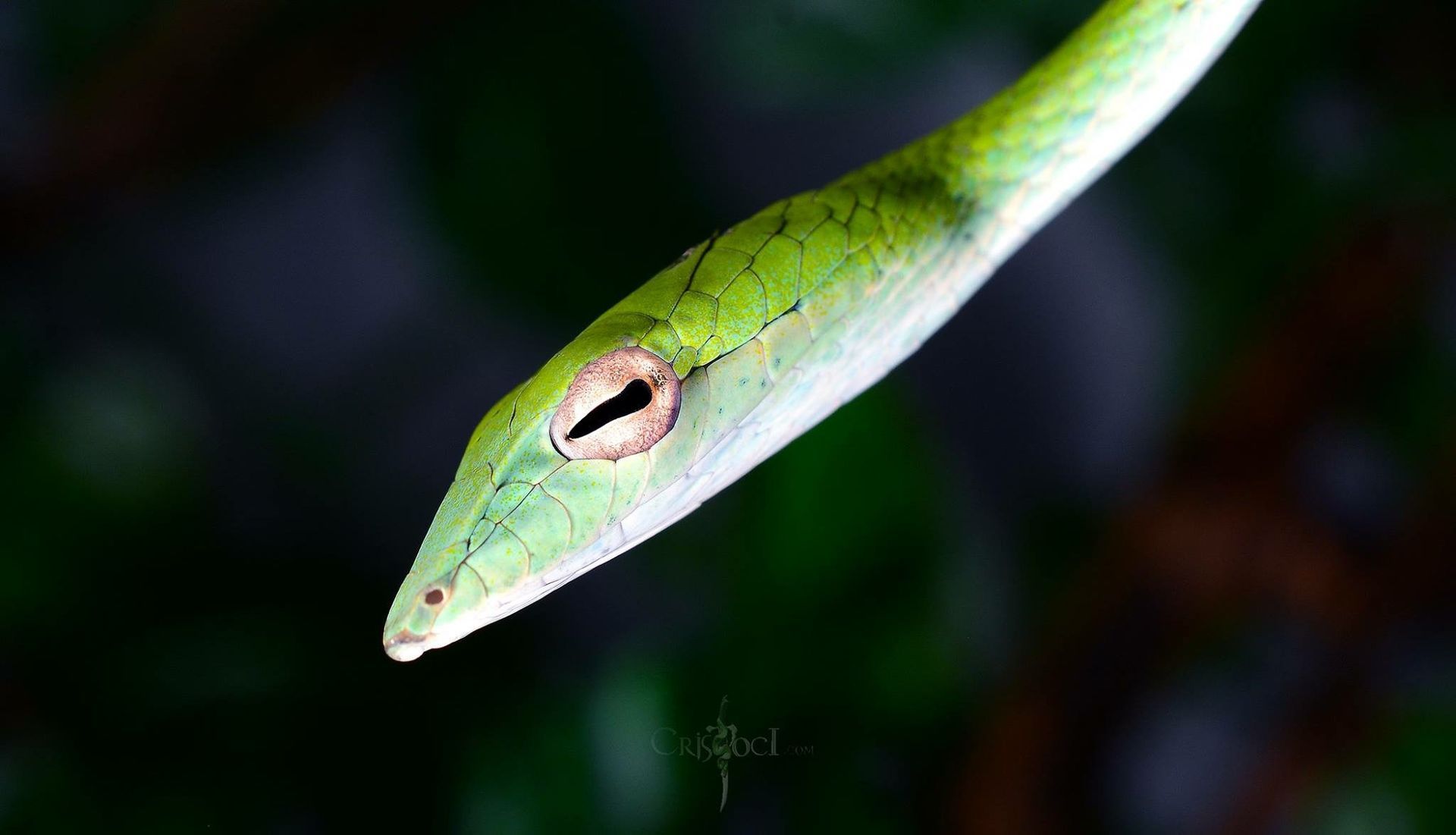
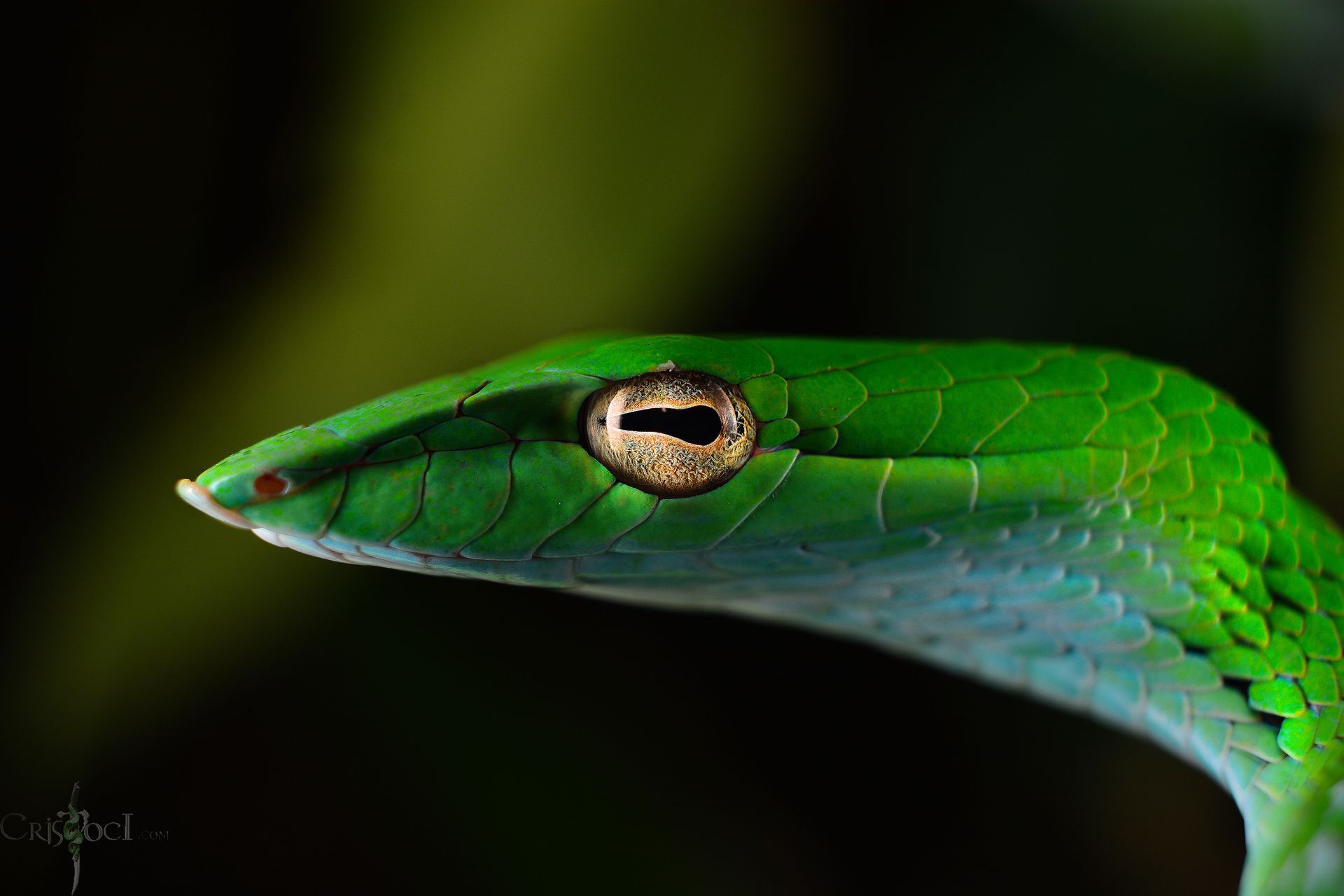
Ahaetulla prasina – Green Vine Snake 🇩🇪 🇬🇧
Husbandry and breeding experience since 2017
⸻
Ahaetulla prasina – Green Vine Snake (Boie, 1827)
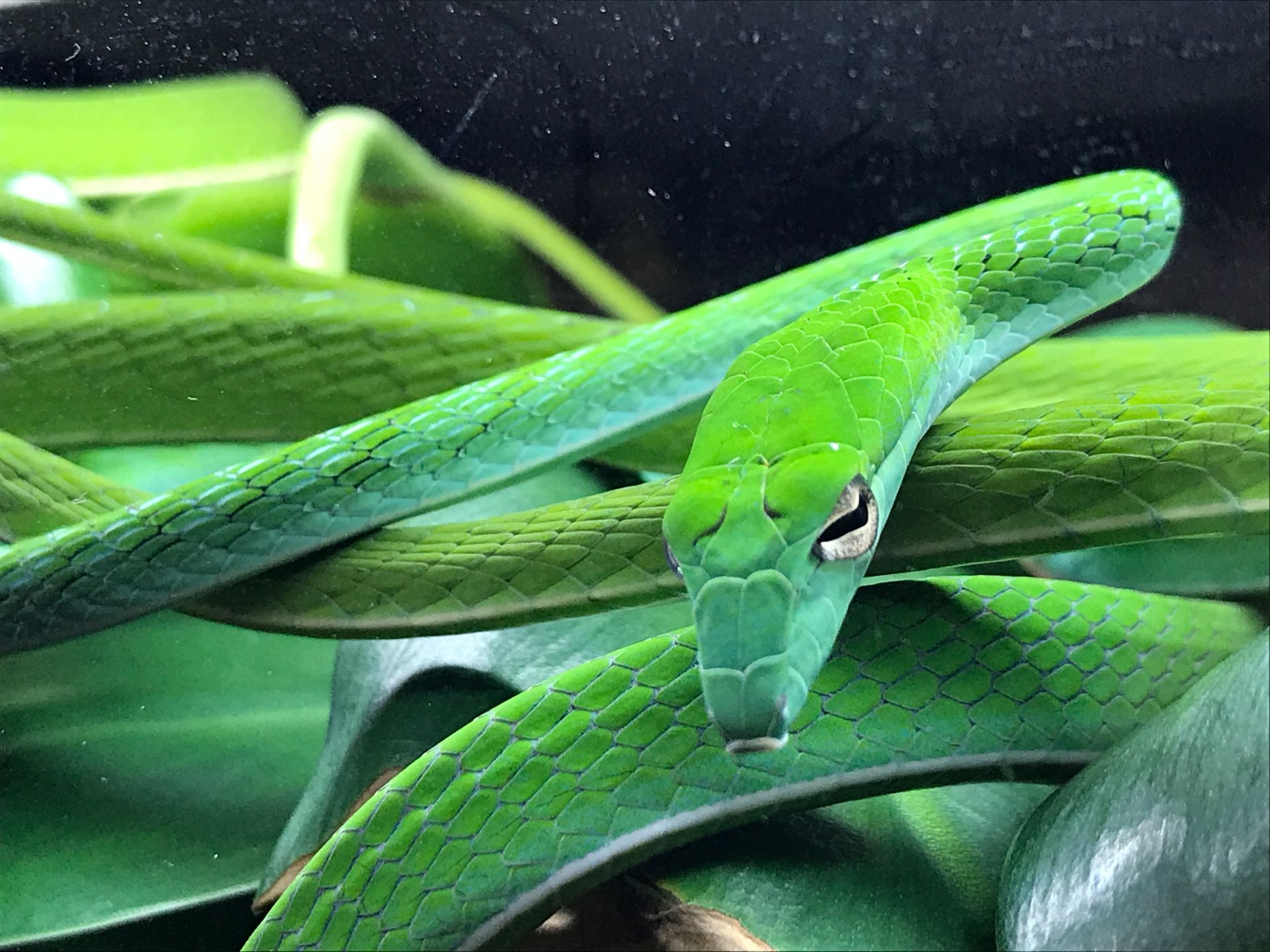
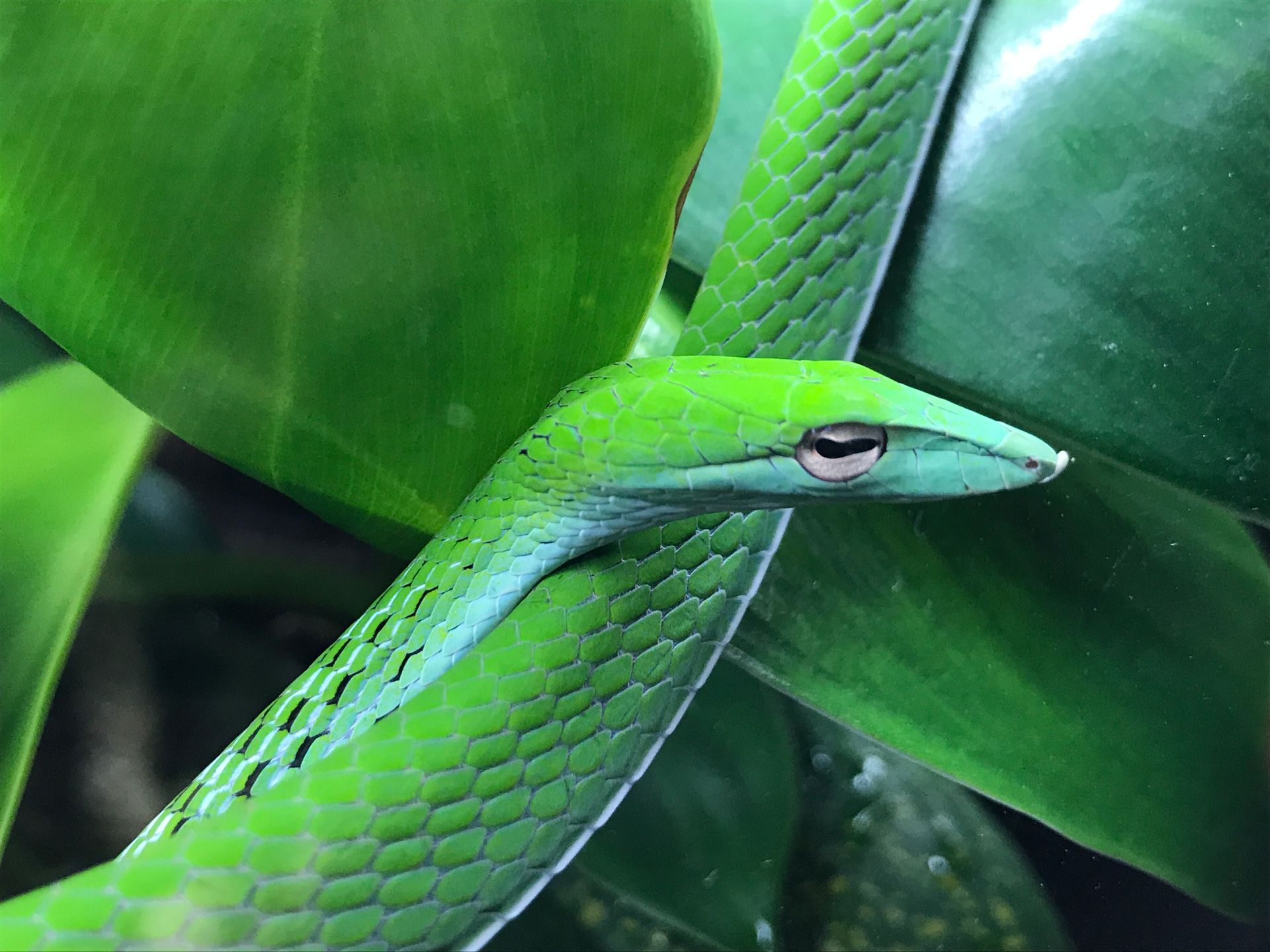
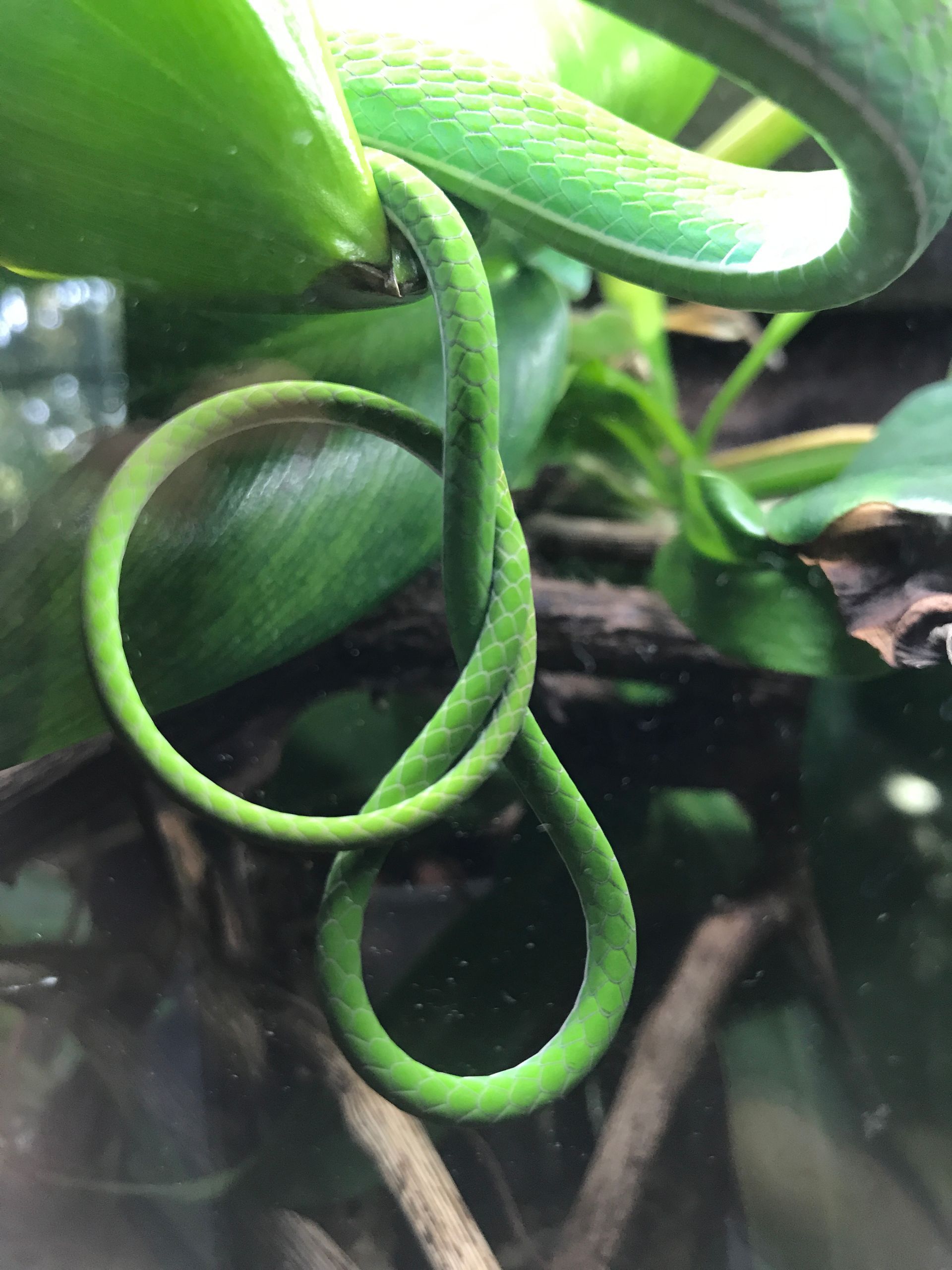
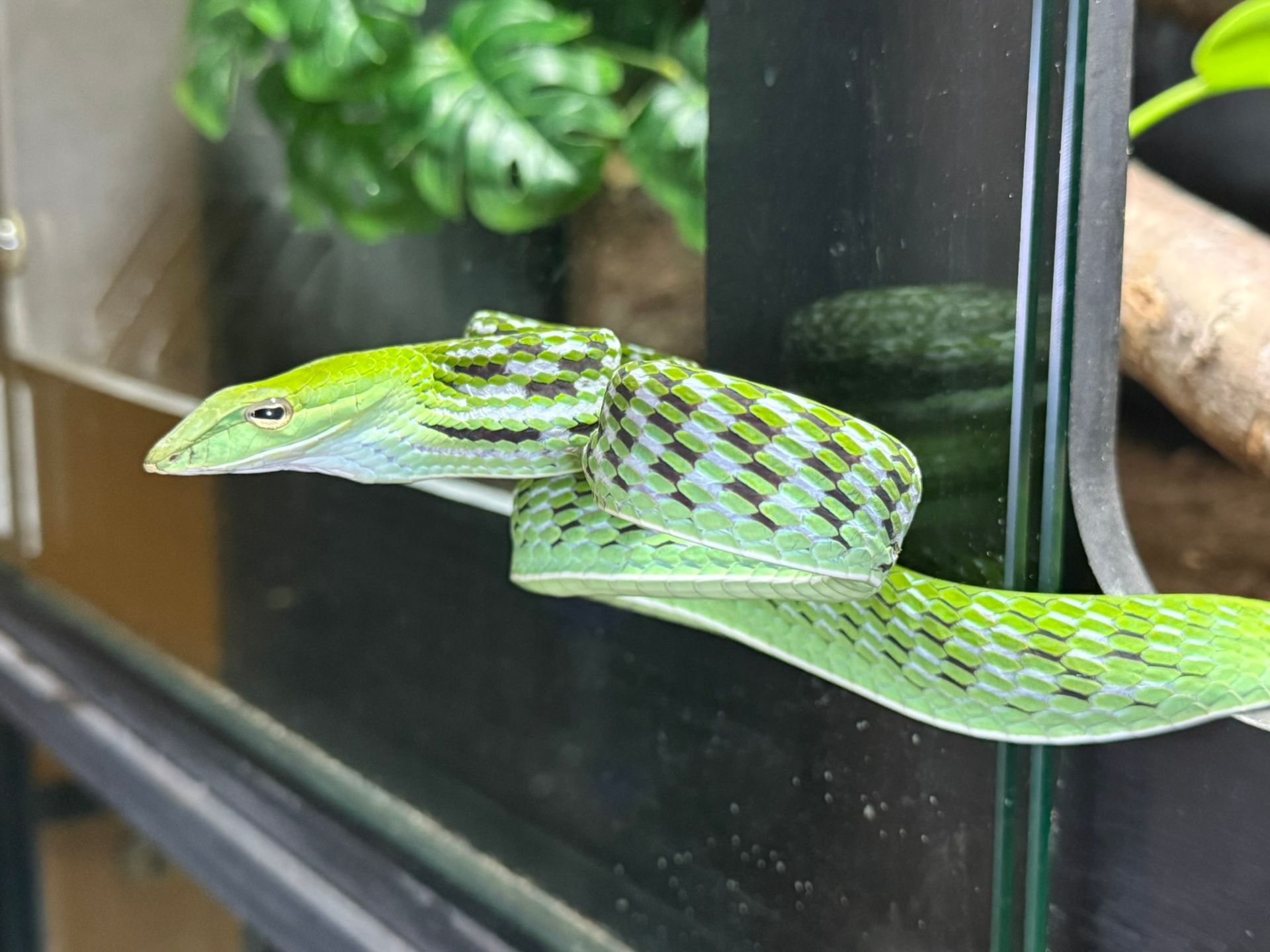
For me, Ahaetulla prasina is one of the most fascinating snakes of all. Its combination of an extremely slender body, large eyes, remarkable camouflage and unique hunting technique makes it one of the most interesting arboreal colubrids.
I have been working intensively with this species since 2017. In addition to keeping them, my main focus is on observing their natural behaviour, diet and successful captive breeding.
In 2019, I achieved my first successful breeding. Since then, I have continued working with my animals and their offspring.
The information on this page is based not only on published literature, but to a large extent on my own experience from several years of keeping and breeding.
⸻
Taxonomy
Scientific name:
Ahaetulla prasina (Boie, 1827)
Common name:
Green Vine Snake
Other names:
Green vine snake
Oriental Whipsnake
Asian Vinesnake
Vine snake
Green vine snake
⸻
Subspecies
Several subspecies of Ahaetulla prasina are described:
Ahaetulla prasina prasina (Boie, 1827)
Ahaetulla prasina medioxima Lazell, 2002 – Shek Kwu Chau Island
Ahaetulla prasina preocularis (Taylor, 1922) – Philippines, including the Sulu Archipelago, Panay and Luzon
Ahaetulla prasina suluensis Gaulke, 1994 – Philippines, Sulu Archipelago
⸻
Habitat and distribution
Ahaetulla prasina has a very large range across South and Southeast Asia.
The species occurs from lowland regions to elevations of around 1,370 metres.
Adults live mainly in trees and shrubs. Juveniles may also be seen foraging on the ground more often.
Typical habitats include:
tropical rainforests
open forests
Secondary forests
Bushland habitats
Gardens and densely vegetated areas in human surroundings
Their body shape and coloration make them perfectly adapted to life in vegetation.
The range includes, among other areas:
Sri Lanka
India
China
Thailand
Malaysia
Indonesia
numerous island regions of Southeast Asia
⸻
Behavior
Ahaetulla prasina is a diurnal, sometimes crepuscular, fully arboreal snake.
This species is a specialized ambush predator. Rather than actively searching for prey, the animals often remain still among branches, waiting for a suitable opportunity.
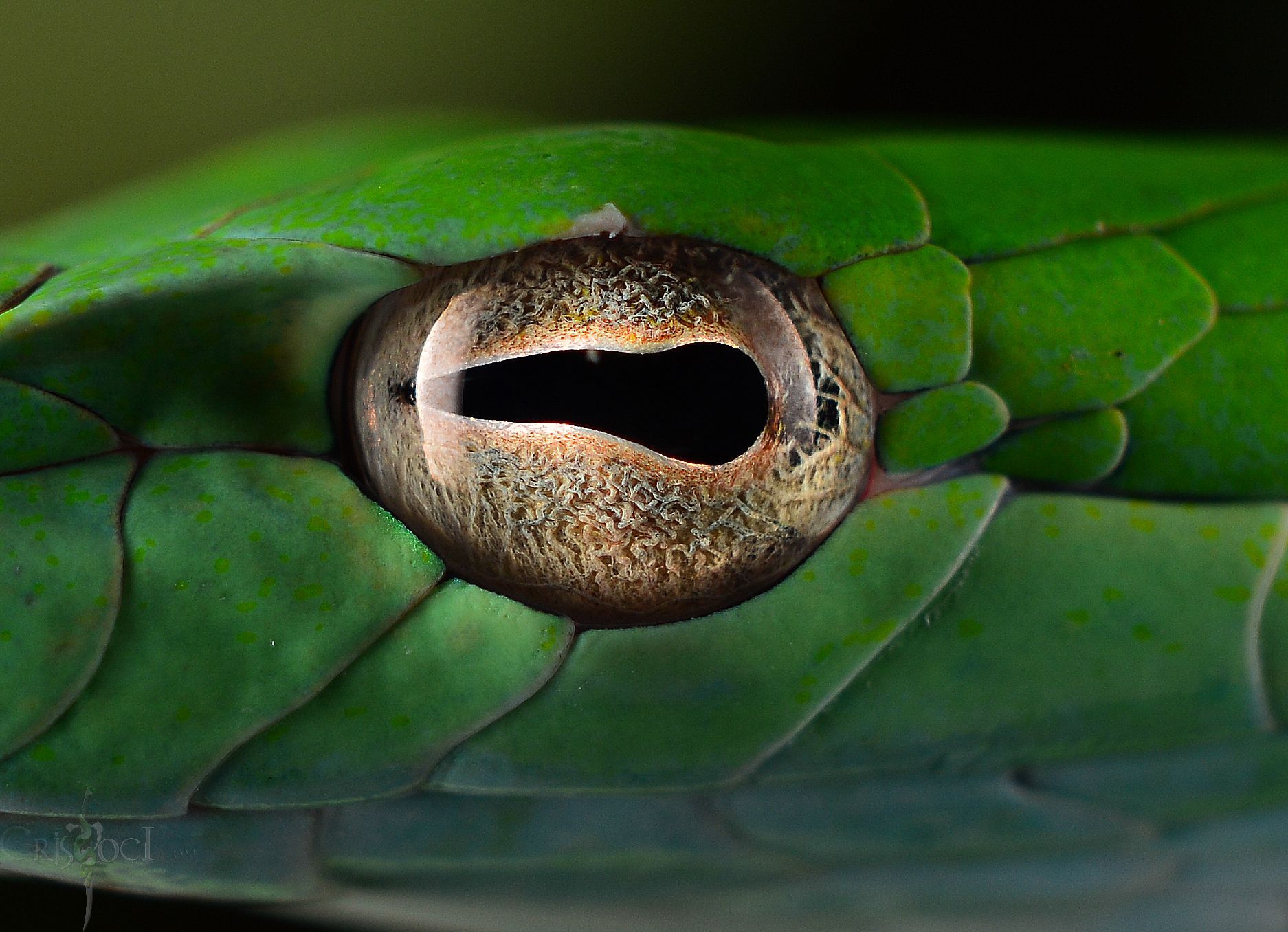
Their most important sense is their exceptionally keen eyesight.
While many snakes rely heavily on scent and the Jacobson’s organ, Ahaetulla prasina relies mainly on its eyesight when hunting.
The animals detect the slightest movements and can accurately assess their prey over long distances.
⸻
Venom
Ahaetulla prasina is an opisthoglyphous colubrid.
The grooved fangs are located far back in the upper jaw.
The venom is used primarily to subdue prey lizards. The species is considered to be of little medical significance to humans.
In my own experience, I noticed no clear reaction after several bites. Nevertheless, these animals should be treated with respect, and a bite should never be deliberately provoked.
⸻
Other
Ovoviviparous (live-bearing).
Conservation Status
The snakes are not subject to any special protection status.
Keeping this species does not require registration in most German states.
Ahaetulla can be kept in most German states and are not on the list of prohibited reptiles in Germany, with the exception of Bavaria.
Before purchasing, please check whether keeping this species is permitted in your state and whether it must be registered.
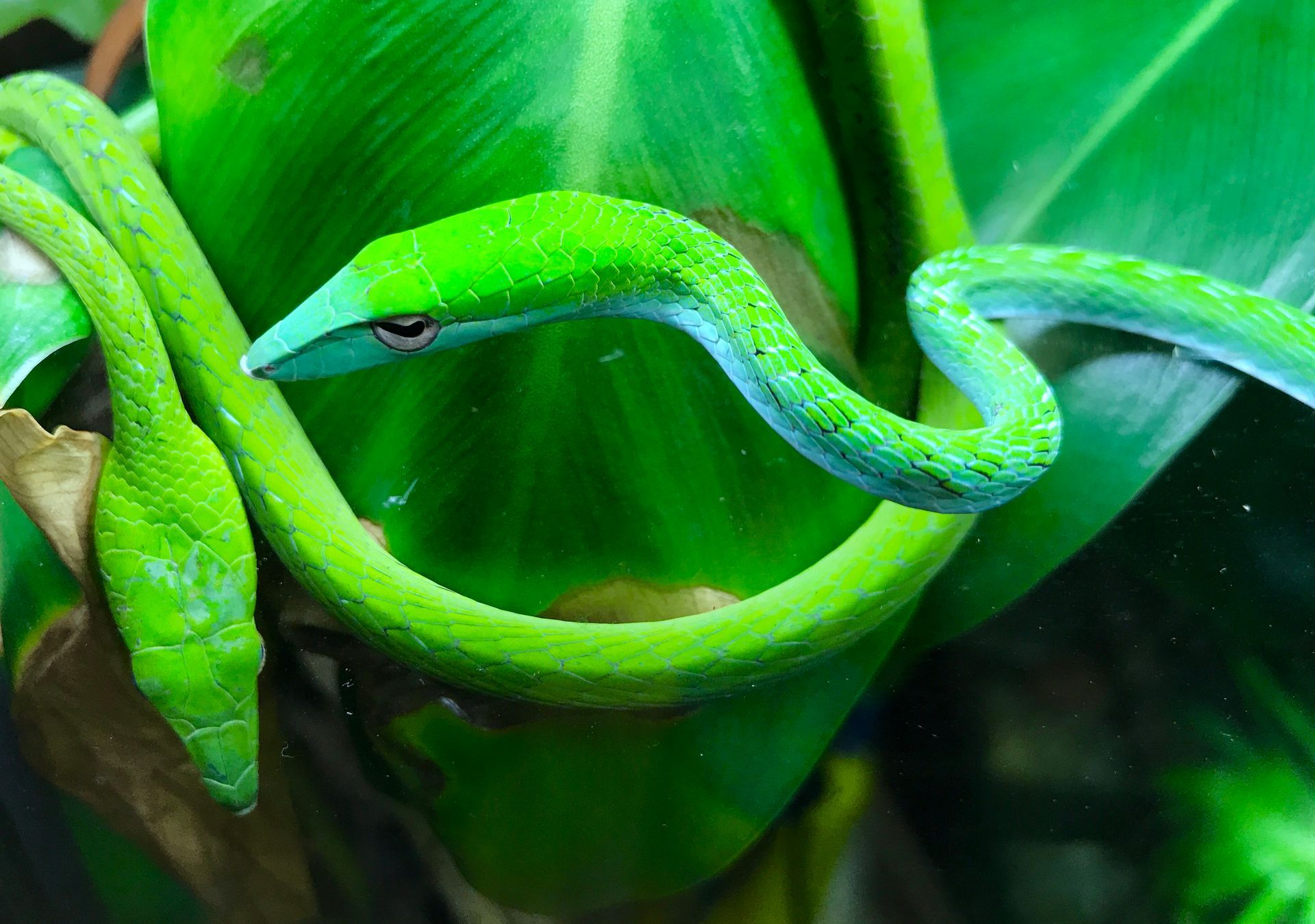
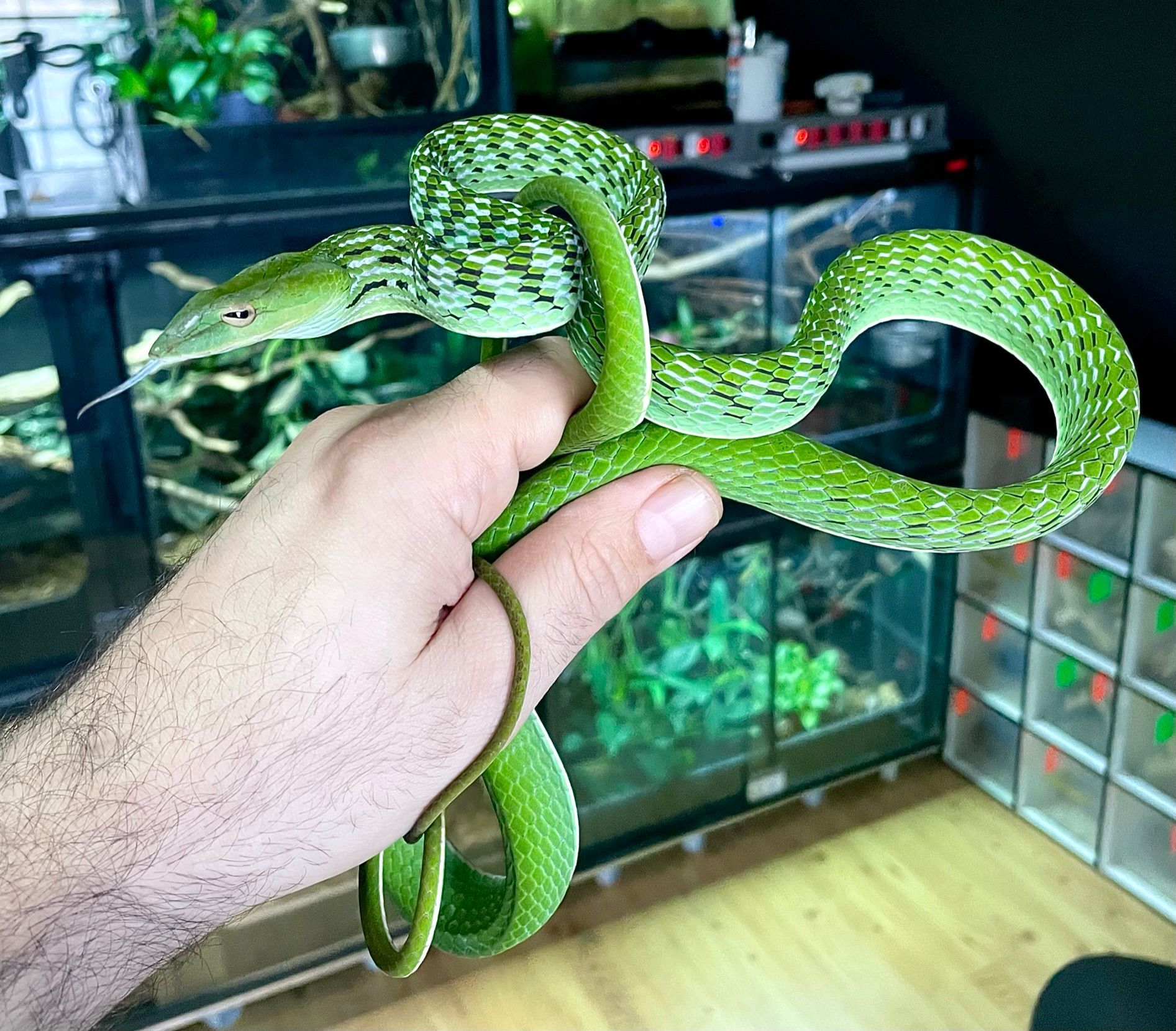
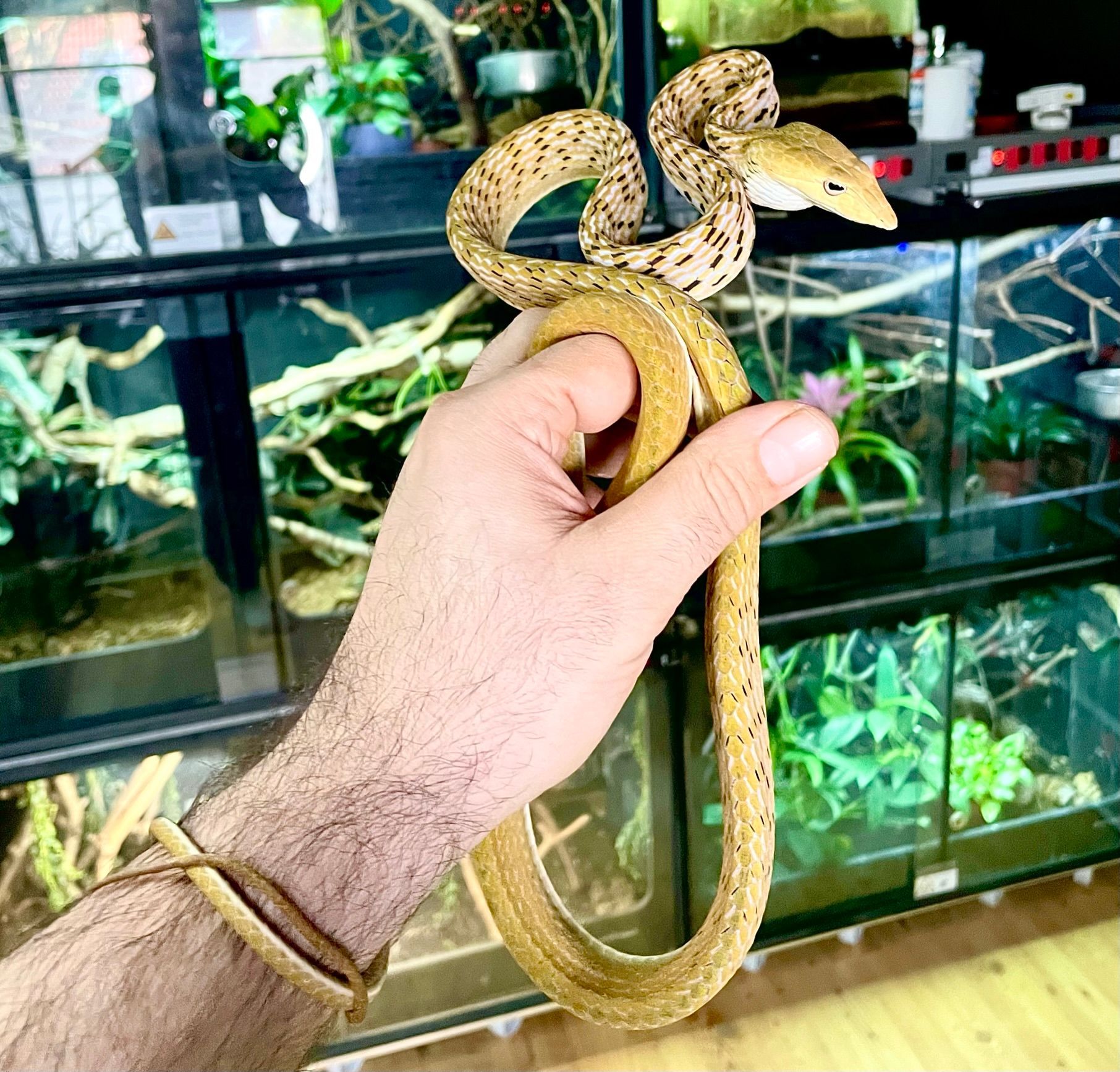
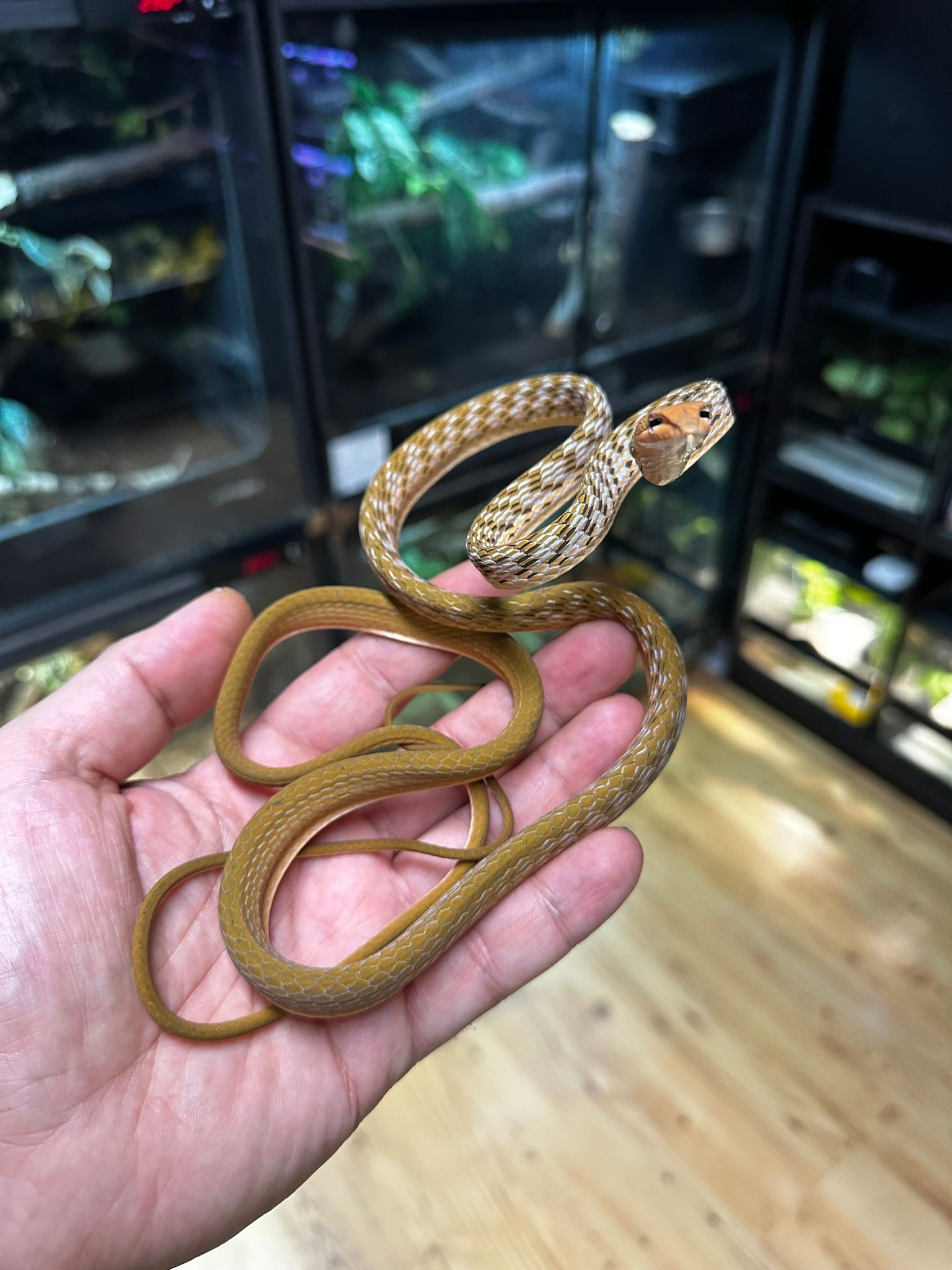
My experience keeping them since 2017
When I began keeping Ahaetulla prasina in 2017, I knew that this species had different requirements from many of the snakes traditionally kept in terrariums.
Many accounts describe green vine snakes as delicate, difficult, or nearly impossible to keep. Based on my own experience, I take a more nuanced view.
Die Tiere sind sicherlich keine typische Anfängerschlange, aber bei passenden Bedingungen können sie sich als erstaunlich robuste und interessante Pfleglinge erweisen.
In my view, the greatest challenges lie not in the actual care, but in understanding their natural lifestyle—particularly their diet, acclimation, and creating a suitable terrarium climate.
⸻
Acclimatising my animals
Within one year, I was able to acquire four animals from three different sources.
Three of these animals were recently imported wild-caught specimens. The fourth was an adult yellow female that had already been acclimated to terrarium life for about two years.
All the animals showed good adaptability from the outset:
they readily accepted their preferred food (lizards),
shed without difficulty,
showed normal activity,
and developed steadily.
Nevertheless, clear differences were observed between recently imported animals and those that had already acclimated.
⸻
Behaviour During the Initial Period
Recently imported Ahaetulla prasina are often very sensitive to external stimuli.
My animals initially showed a strong tendency to flee.
As soon as they noticed movement outside the terrarium, they tried to escape or sought shelter within the vegetation.
Even during work in the terrarium, some animals initially responded with clear defensive behavior:
they raised their bodies,
displayed defensive behaviour,
and tried to escape with quick movements.
However, this behaviour changed significantly as the animal became more acclimated.
After about eight to twelve months, I noticed that the animals had become much calmer.
Escape responses occurred far less frequently, and working in the terrarium became much easier.
My experience therefore suggests that many negative descriptions of this species are heavily influenced by the stress of recently imported animals.
In my opinion, a calm settling-in period without unnecessary disturbance is one of the most important factors for successful keeping.
⸻
Escape behaviour
One characteristic of Ahaetulla prasina should never be underestimated:
These animals are extremely fast.
Their slender bodies and excellent coordination allow them to move with impressive speed.
Especially at first, great care should be taken when opening the terrarium.
For example, with my first Ahaetulla prasina, the animal sprang out at lightning speed several times when I opened the doors.
Not every animal exhibited this behaviour, but with wild-caught specimens in particular, you should always expect an escape attempt.
At night, however, the animals are usually quiet. They rest on branches and rely entirely on their extraordinary camouflage.
⸻
Activity and daily routine
Ahaetulla prasina is predominantly diurnal.
At night, the animals usually sit quietly in their preferred resting spots.
They become active at the start of the day:
they change their position,
seek suitable basking spots,
carefully observe their surroundings,
and react to the slightest movement.
Their large eyes are among the most striking features of this species.
I would argue that Ahaetulla prasina have some of the most impressive eyesight of any snakes I have observed so far.
⸻
Exceptional eyesight
Ahaetulla prasina’s hunting style differs significantly from that of many other snake species.
While many snakes track their prey mainly through smell and chemical cues, Ahaetullas rely predominantly on sight when hunting.
Their eyes enable them to:
very accurate distance estimation,
detecting the slightest movements,
and an extremely precise strike.
For this reason, I consider some common claims about this species questionable.
For example, you often read that mice can be made more appealing by rubbing them with lizard skin scent. In my experience, this does not reflect these animals’ natural hunting behaviour.
Ahaetulla prasina responds primarily to movement and shape.
⸻
Special Considerations When Tongue-Flicking
Another interesting observation concerns the characteristic tongue-flicking.
Unlike many other snake species, my Ahaetulla prasina use their tongues very little while hunting.
The tongue often remains extended straight out and almost motionless for long periods.
I cannot say for certain exactly what function this behaviour serves. However, based on my observations, it is not directly linked to conventional, scent-based prey detection.
⸻
Hunting Behaviour – Precision from Ambush
Eines der faszinierendsten Merkmale von Ahaetulla prasina ist ohne Zweifel ihr außergewöhnliches Jagdverhalten.
In the terrarium, the animals often give the impression that they are constantly searching for food. They move slowly through the branches, change position, and carefully observe their surroundings.
In reality, however, they spend much of their time as typical ambush predators.
They often sit on a branch facing forward, with their heads slightly raised from their bodies, patiently waiting for the right opportunity.
⸻
Perfect camouflage as a hunting strategy
The movements of Ahaetulla prasina are unique.
As the animals move slowly through the terrarium, their movements strongly resemble a thin branch swaying in the wind.
This combination of:
slender body,
slow movement,
perfect coloration,
and patiently waiting
makes her almost invisible to her prey.
Lizards in particular often react very late to the presence of an Ahaetulla.
⸻
The Attack
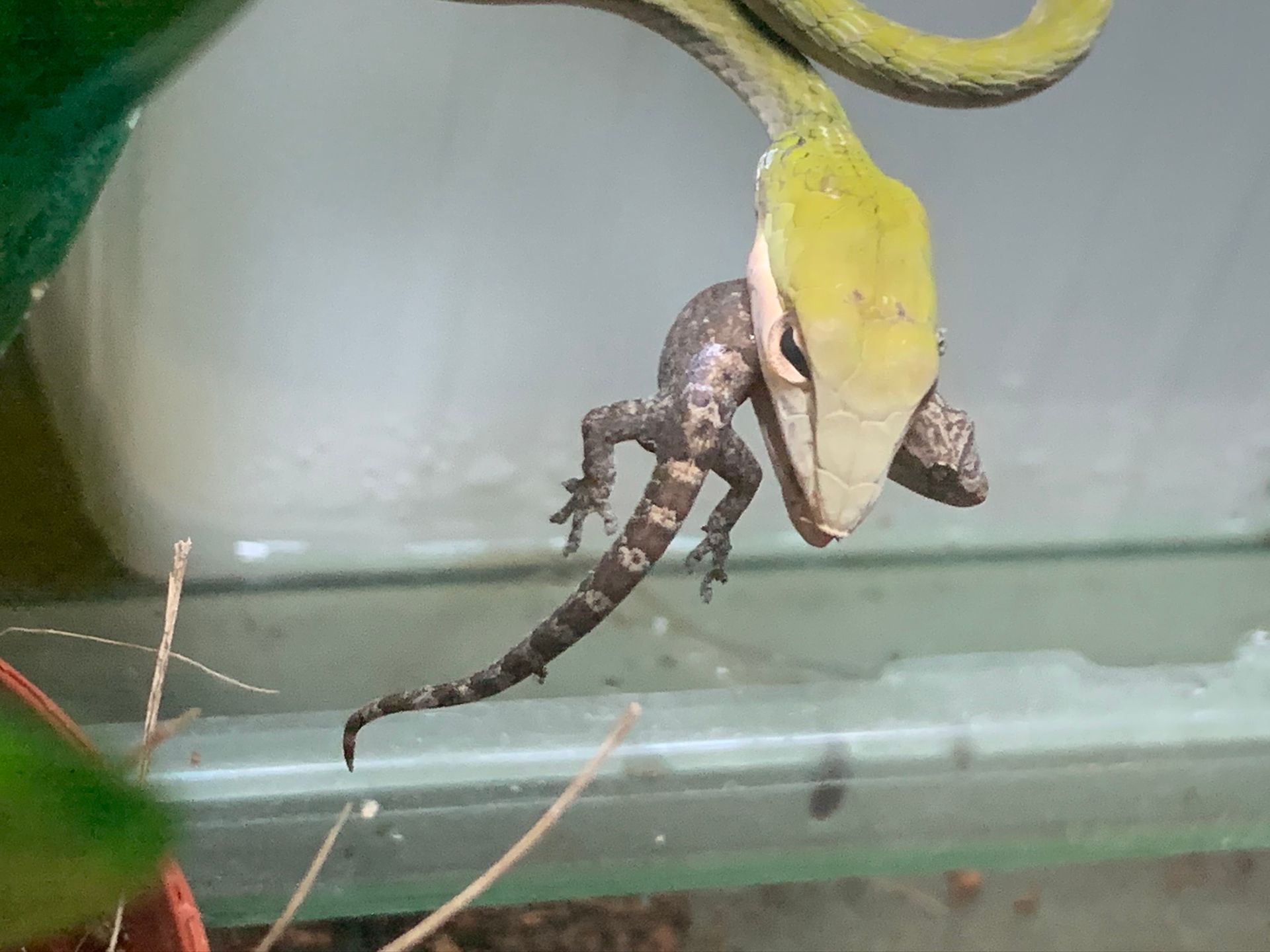
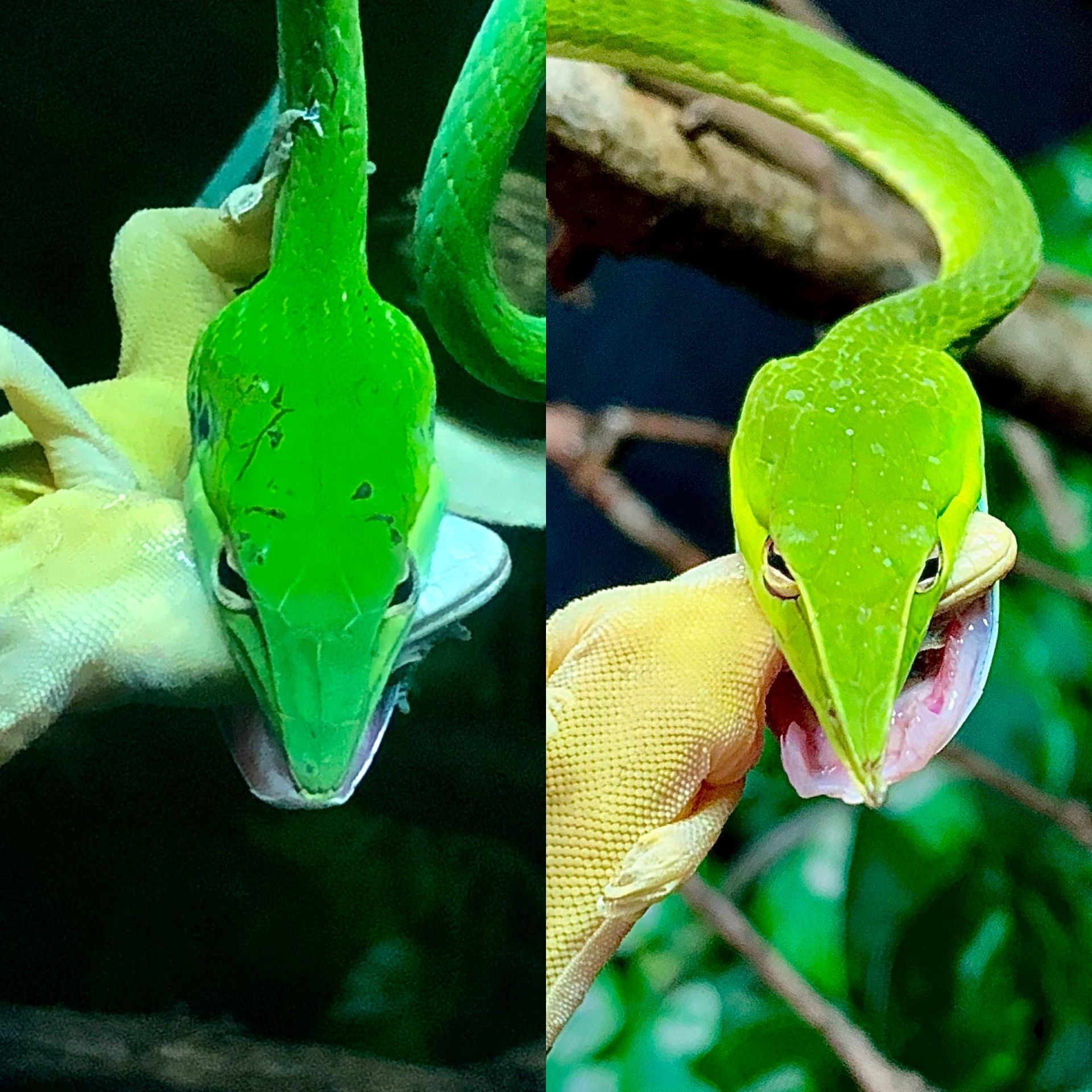
As soon as suitable prey is within range, the strike is extremely fast and precise.
Most attacks are made from an elevated position.
The snake often targets the lizard's head or neck.
During the time I kept them, I was able to observe several times just how accurately these animals hunt.
One particularly impressive observation was an animal that stretched forward to nearly 80% of its body length and seized a basilisk on the ground precisely by the neck.
Such observations clearly show how perfectly this snake is adapted to hunting in the branches.
For me, Ahaetulla are among the most precise hunters of all snakes.
⸻
Subduing prey
After successfully catching its prey, the snake initially holds it firmly and begins making chewing motions.
This allows the rear fangs to be inserted into the prey, enabling the venom to take effect.
Ahaetulla prasina is an opisthoglyphous colubrid.
The fangs are located far back in the upper jaw, approximately beneath the eyes.
The venom is primarily used to quickly subdue lizards.
The exact composition and effects may vary by species and individual. The extent to which the venom actually affects different prey animals has not yet been fully established scientifically.
In my observations, smaller lizards can be affected relatively quickly.
However, larger prey can take significantly longer.
Even so, the animals often begin swallowing their prey while the venom is still taking effect.
⸻
Personal Experiences with Bites
I have been bitten by Ahaetulla prasina several times while keeping them.
I observed no noticeable reactions.
However, it is important to note that I have never deliberately provoked the animals to bite or created situations that would make an attack more likely.
Images occasionally appear online of keepers holding several Ahaetullas or working in very close proximity to the animals.
Personally, I see no advantage in it.
In my opinion, a calm and respectful approach is the right way.
There is no reason not to wear gloves when working in the terrarium or handling the animals.
⸻
Handling and removing the animals
Not every animal can be moved easily with a snake hook.
For example, among my own animals, three out of four do not reliably stay on the hook.
That’s why I use gloves when needed and handle the animals carefully.
It should always be kept in mind:
Although Ahaetulla prasina appears delicate, it is a specialised venomous snake that moves very quickly.
The animals should never be underestimated.
⸻
Summary of Hunting Behavior
For me, the hunting behavior of Ahaetulla prasina is one of the main reasons this species is so fascinating.
It combines:
exceptional eyesight,
perfect camouflage,
controlled movements,
incredible precision,
and a specialized adaptation to lizard-rich habitats.
Anyone keeping these animals should not only focus on basic care, but also take the time to observe their behavior.
Because these observations are precisely what make this species so fascinating.
⸻
Group or individual housing
At the beginning of keeping this species, I housed two male Ahaetulla prasina together, initially thinking they might form a harmonious pair.
In principle, keeping these animals together is possible. Keeping several animals in a sufficiently large, well-structured terrarium can also work.
However, based on my own experience, I have reservations about keeping them together.
For me, the most important thing is monitoring food intake.
⸻
Problems with cohabitation
When feeding them together, I observed clear differences between the animals.
The two males differed in their hunting success. While one regularly caught prey and ate well as a result, it was much harder to monitor how much the other was actually eating.
I consider careful monitoring of food intake very important, especially with specialized lizard-eaters.
The aim is to ensure that every animal gets enough food and that no individual is consistently disadvantaged.
My animals also had two aggressive encounters during feeding.
These observations were the deciding factor in my decision to house the animals individually in the future.
⸻
Risk of intraspecific conflict
Although Ahaetulla prasina is often described as a calm and gentle snake, it is important to remember that it is an opportunistic predator.
Prey is detected by movement and attacked in a flash.
When housed together, it therefore cannot be ruled out entirely that smaller or weaker animals may be perceived as potential prey.
For example, I saw reports and photos from keepers whose larger animals chased smaller ones of the same species.
I cannot say how often this occurs. However, to me it shows that a certain risk exists.
For this reason, I prefer keeping them individually.
It enables:
better control over feeding,
careful observation of each animal,
less stress,
and better monitoring of their health.
⸻
Climate simulation and natural conditions
When keeping my Ahaetulla prasina, I try to replicate as closely as possible the natural conditions of their native habitats.
I try not only to maintain stable conditions, but also to simulate natural fluctuations.
The following are particularly important to me:
- Temperature differences between day and night,
- fluctuating humidity,
- rainy seasons,
- and good air circulation.
The animals come from tropical regions of Southeast Asia, where conditions are not entirely constant either.
⸻
Temperature
During the day, I gradually let the temperatures rise to around 30 °C.
My average daily readings are approximately:
- 28–29 °C during the day
- 21–23 °C at night
I consider this nighttime temperature drop an important part of their care.
It gives the animals a natural rhythm and prevents temperatures from remaining too high.
Lighting duration is approximately 12 hours per day.
⸻
Inducing mating through climatic conditions
Simulating natural conditions produced interesting results with my animals.
After introducing a male to a female in early June, I observed the first courtship activity after about a week.
Within one month, I documented a total of five matings.
There were approximately four to five days between each pairing.
No further activity was observed after that.
What I found particularly interesting was that the male continued to eat normally throughout this entire period.
Many other snake species often eat less during the breeding season. I did not observe this behaviour in my Ahaetulla prasina.
⸻
Humidity and Misting
I maintain humidity at around 60–90%, depending on the time of day and season.
I use both manual spraying and an automatic misting system.
During the simulated rainy season, the misting system runs:
- two to three times daily,
- at varying intervals.
Outside this period, the enclosure is sprayed daily.
High humidity is important, but above all, a good balance between moisture and ventilation is essential.
A constantly wet environment without sufficient air circulation can be problematic.
Although Ahaetulla prasina lives in humid tropical habitats, even there the substrate is not constantly waterlogged.
⸻
Drinking behaviour
It is often claimed that Ahaetulla prasina only drinks moving water.
I was unable to confirm this in my own animals.
I have offered various options:
- Water bowls on the floor,
- water bowls among the branches,
- flowing water sources.
Nevertheless, I have not yet observed them deliberately drinking from these sources.
What I regularly see is them drinking water droplets after leaves and branches have been misted.
In my experience, the species appears to meet its water needs mainly from surface water.
Nevertheless, I still consider providing additional water sources worthwhile.
As with many observations, the same applies here:
My experience is based on my own animals. Other keepers may well make different observations.
⸻
Terrarium, equipment and furnishings
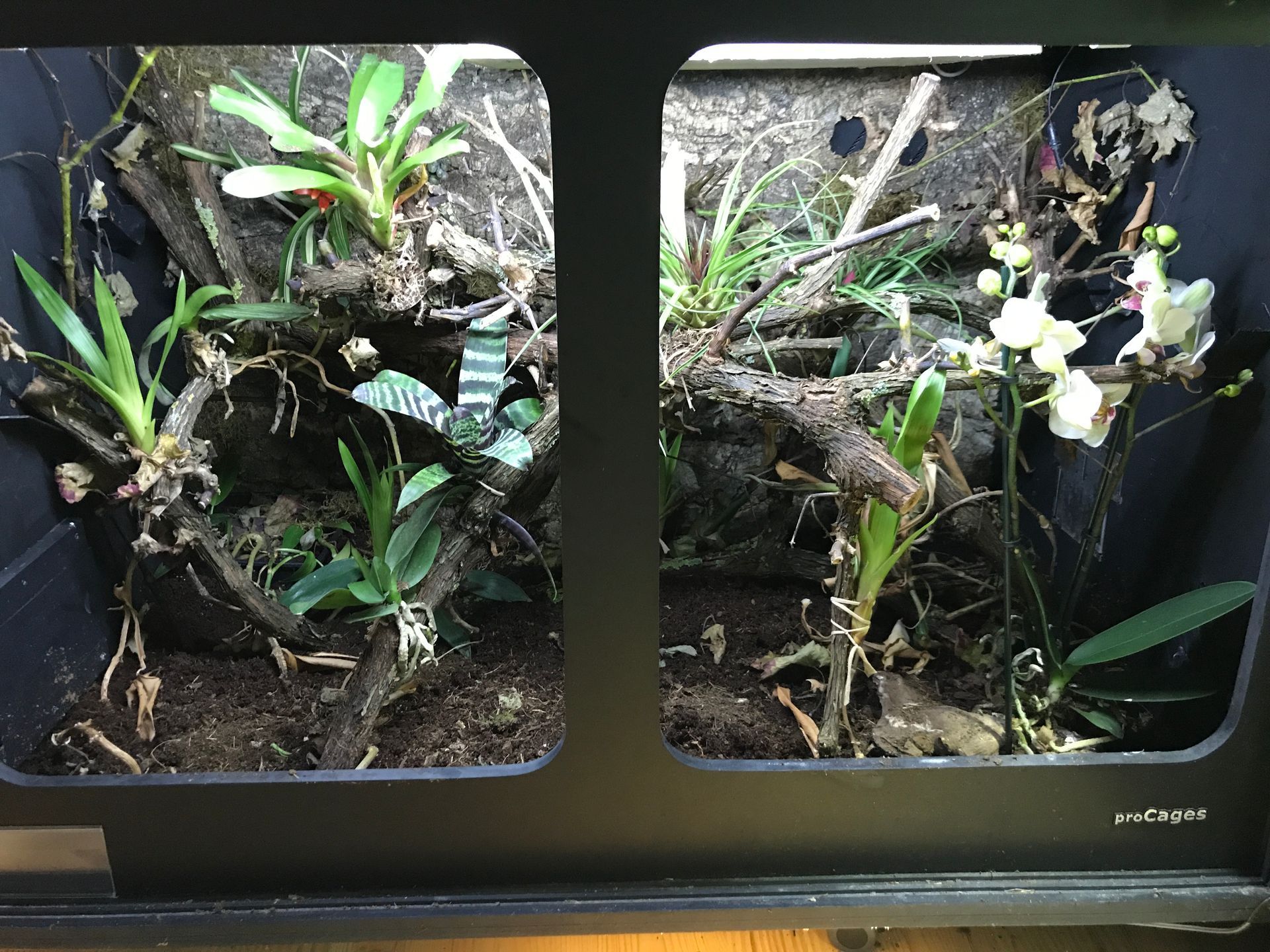
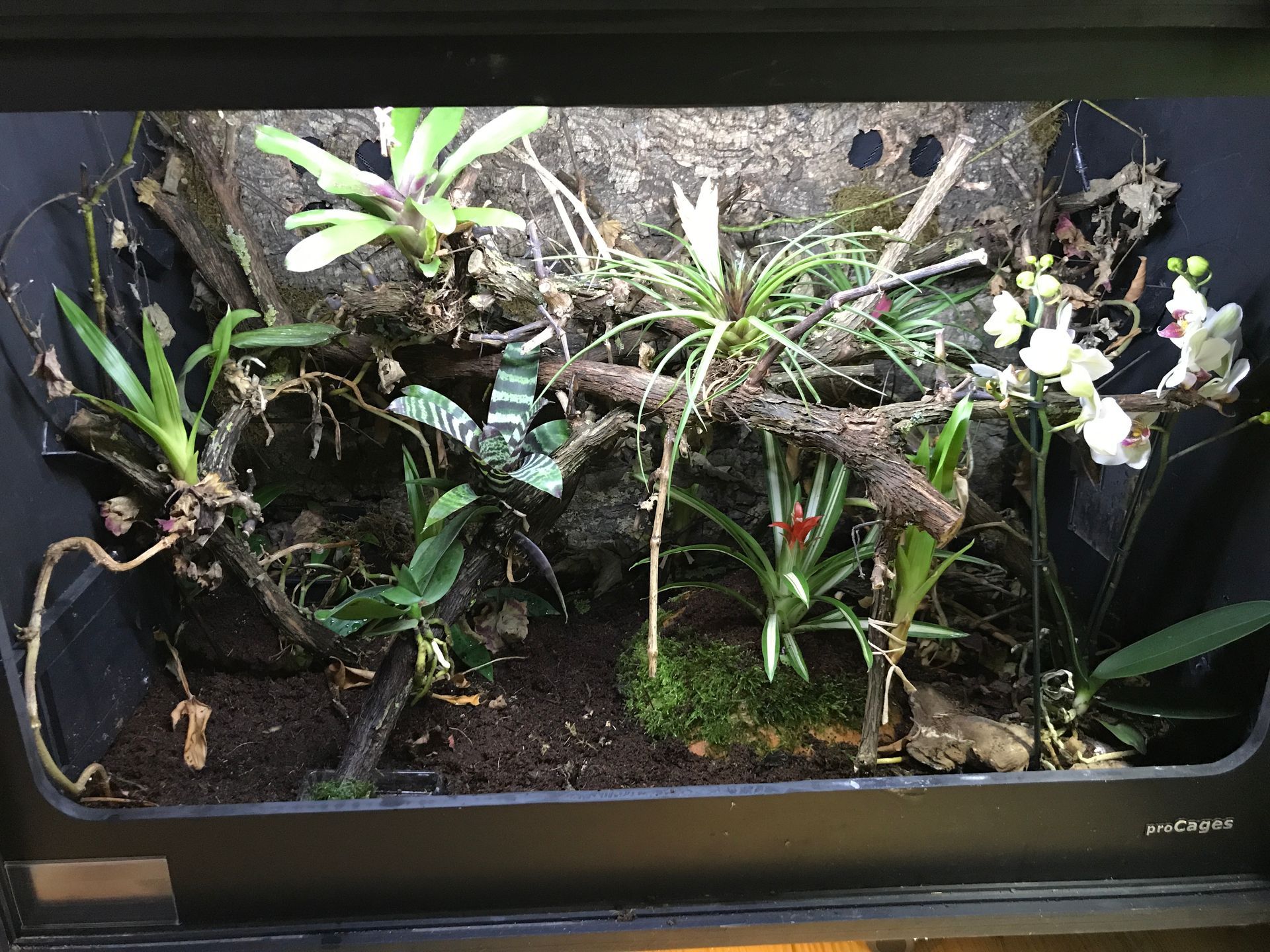
The right terrarium setup is a crucial factor for Ahaetulla prasina.
This species spends nearly its entire life in vegetation and makes intensive use of the available space. A suitable terrarium should therefore not only be large enough, but above all provide plenty of climbing opportunities and places to hide.
For me, the setup is about function, not just appearance:
The snake must be able to move around safely, find suitable resting places, and express its natural behaviours.
⸻
Terrarium Size and Materials
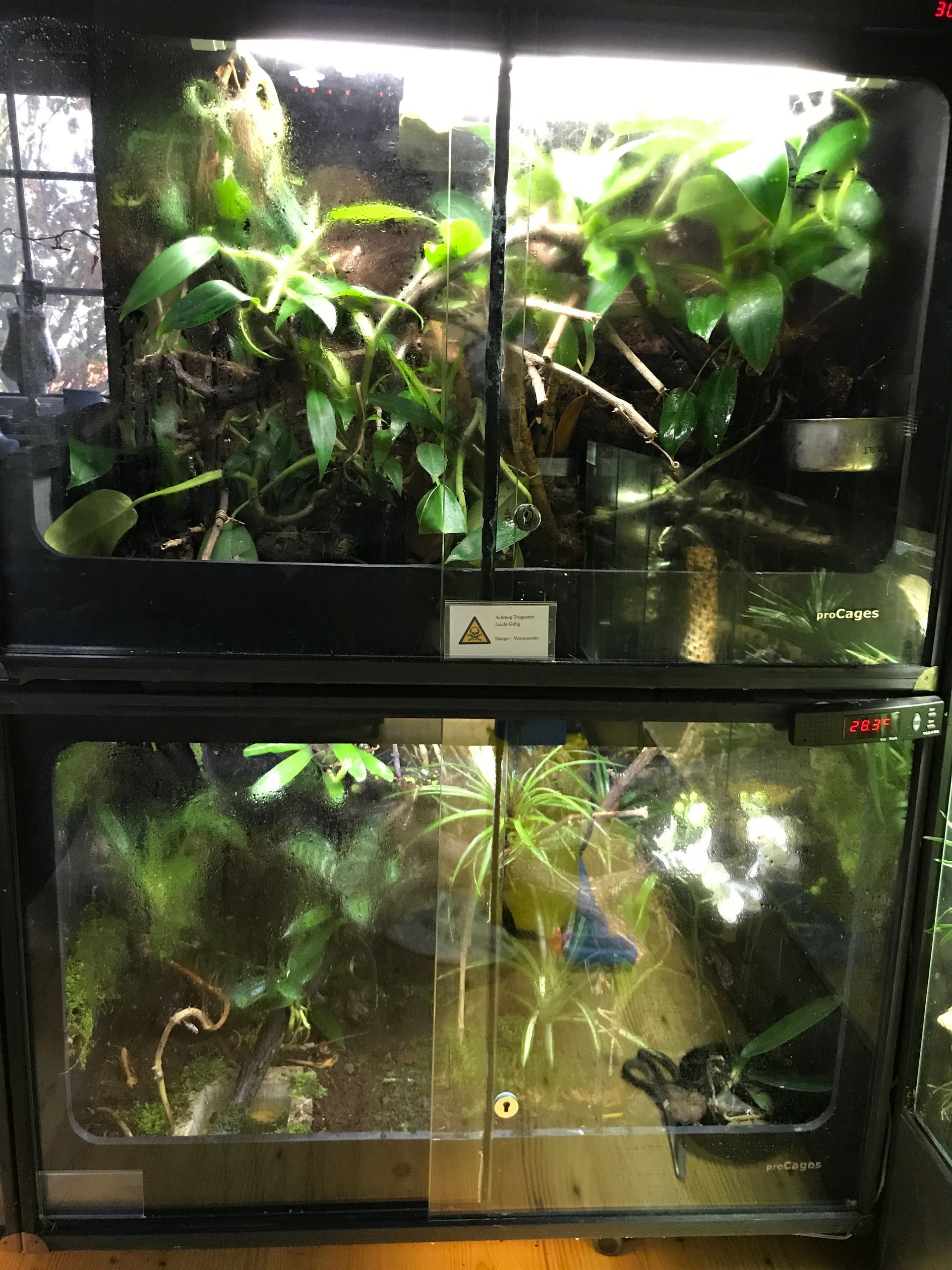
My terrariums are made of black PVC with a material thickness of 12 mm.
My enclosures range in size from:
- 90 × 60 × 60 cm
- 120 × 60 × 60 cm
However, I would recommend larger terrariums for particularly large animals measuring up to 200 cm in length.
Although Ahaetulla prasina does not require as much space as a bulky snake due to its very slender body, its need to move around should not be underestimated.
The animals mainly use the vertical space and regularly move throughout the entire terrarium.
⸻
Ventilation and air circulation
An important aspect of keeping tropical species is balancing high humidity with adequate ventilation.
For this reason, I equipped my terrariums with adjustable ventilation.
This allows me to adjust the conditions more effectively depending on the season.
My terrariums also contain small fans to improve air circulation.
Good air circulation is particularly important in humid conditions, as stagnant, humid air can cause problems over time.
⸻
Lighting
Each of my terrariums is equipped with UVA/UVB lighting in the form of a 24-watt T5 tube.
The importance of UV light in Ahaetulla prasina is debated.
In my view, however, the animals benefit from high-quality lighting.
This is not only due to possible physiological effects, but also because this species is highly visually oriented.
Bright, natural lighting allows the animals to better perceive their surroundings and supports their natural activity patterns.
I do not use additional lighting systems.
⸻
Heating
My terrariums are heated using Heatpanels installed overhead.
In my opinion, this type of heating better reflects the natural behavior of arboreal animals than relying solely on a heat source from below.
Ahaetulla prasina often sits exposed on branches and uses warm areas in the upper part of the terrarium.
All equipment is controlled via:
- Thermostats,
- Timers,
- and automated controls
regulated.
This keeps the temperature and lighting schedule stable.
⸻
Setup and structure
One of the most important components for Ahaetulla prasina is plenty of suitable climbing branches.
I use many thin branches of varying thickness.
These enable the animals to:
- natural movement,
- secure resting places,
- hunting positions,
- and places to retreat.
Horizontal branches, where the animals can rest comfortably, are particularly important.
The snake should not be forced to spend all its time on the enclosure walls or on just a few main branches.
⸻
Planting
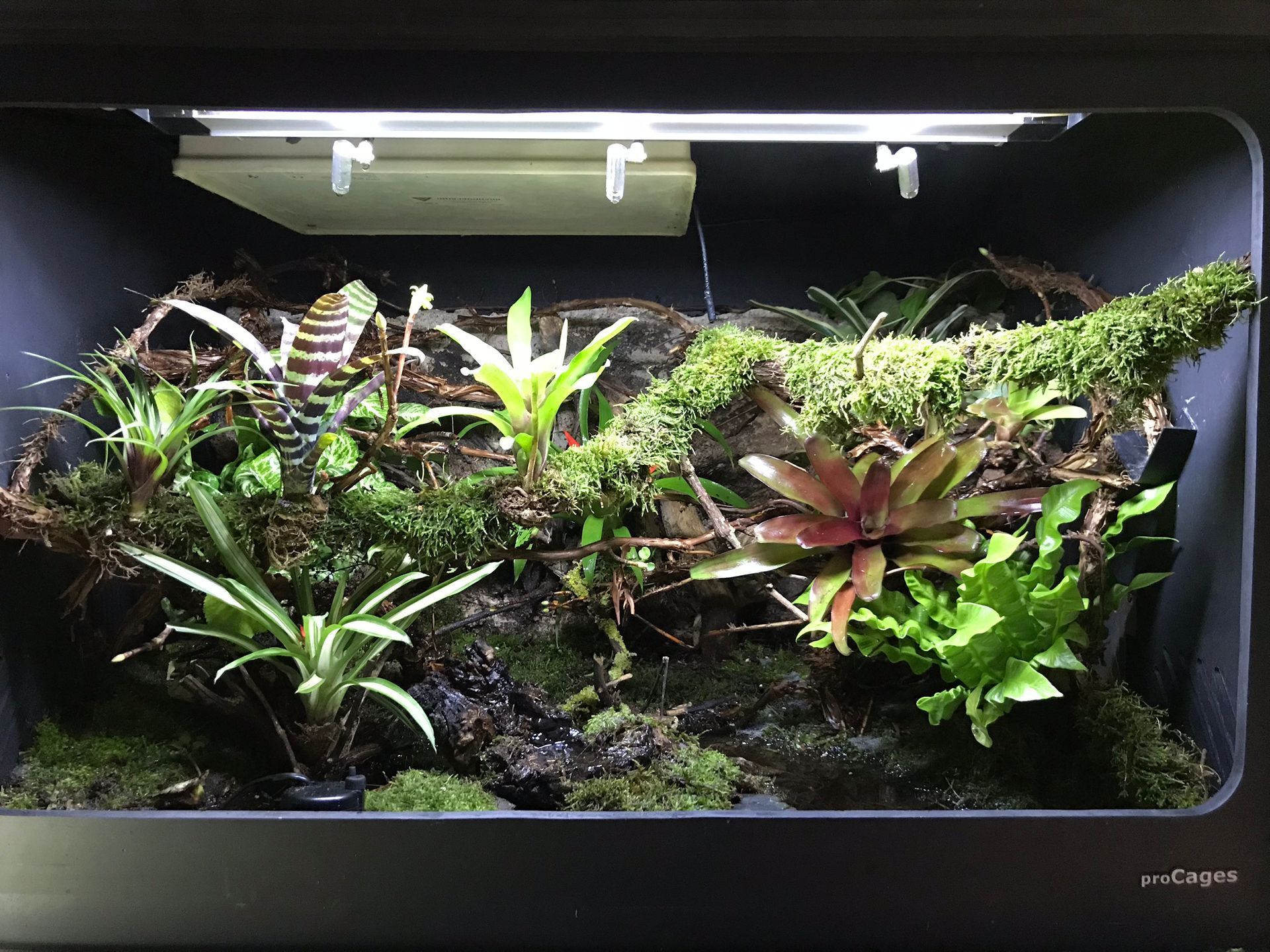
In my opinion, dense planting is an important part of their husbandry.
It offers:
- Safety,
- Visual barriers,
- additional climbing opportunities,
- and a more natural appearance.
Real plants can also be used with appropriate lighting.
Suitable examples include:
- Ficus species
- Ferns
- other tropical plants with similar requirements
Live plants also help create a more stable microclimate in the enclosure.
⸻
Substrate
I use humus soil as the substrate.
Although substrate plays a less significant role for a predominantly arboreal species than for ground-dwelling snakes, it still contributes to the overall terrarium environment.
Above all, the substrate must be able to absorb moisture without staying wet.
⸻
Misting system
The misting system complements the overall climate setup.
Ahaetulla prasina is native to regions with pronounced rainy seasons. Varying the humidity helps recreate natural conditions.
However, it is important to note:
Nicht die maximale Luftfeuchtigkeit ist entscheidend, sondern ein funktionierender Wechsel zwischen feuchten und trockeneren Phasen.
⸻
My Experience with Terrarium Technology
After keeping these snakes for several years, I have concluded that the technical aspects are not the most challenging part of their care.
A suitable climate can be reliably created with modern equipment.
The real challenge remains feeding.
When temperature, humidity, furnishings and lighting are right, Ahaetulla prasina display very interesting, natural behaviour.
However, sourcing suitable feeder animals remains where many keepers struggle.
⸻
Diet – the key to keeping Ahaetulla prasina
If there is one aspect of keeping Ahaetulla prasina that determines success or failure, it is undoubtedly feeding.
Many other aspects of husbandry can be effectively controlled with technology, experience, and careful planning.
The food supply, however, is the real challenge.
Ahaetulla prasina is a highly specialized lizard eater.
Anyone keeping this species must accept that the snake’s natural diet cannot simply be replaced with a more convenient alternative.
⸻
Specialist Snakes
Food specialists are among the most fascinating reptiles of all, in my opinion.
A species’ unusual body shape and way of life often reveal that it occupies a unique ecological niche.
Since becoming more involved with vine snakes and lizard-eating snakes, these species in particular have fascinated me.
Besides Ahaetulla prasina, other specialized lizard hunters are among my favorites.
The appeal lies in the fact that you’re not simply keeping a snake and feeding it mice on a regular basis.
You need to understand the biology of the species.
⸻
Natural diet
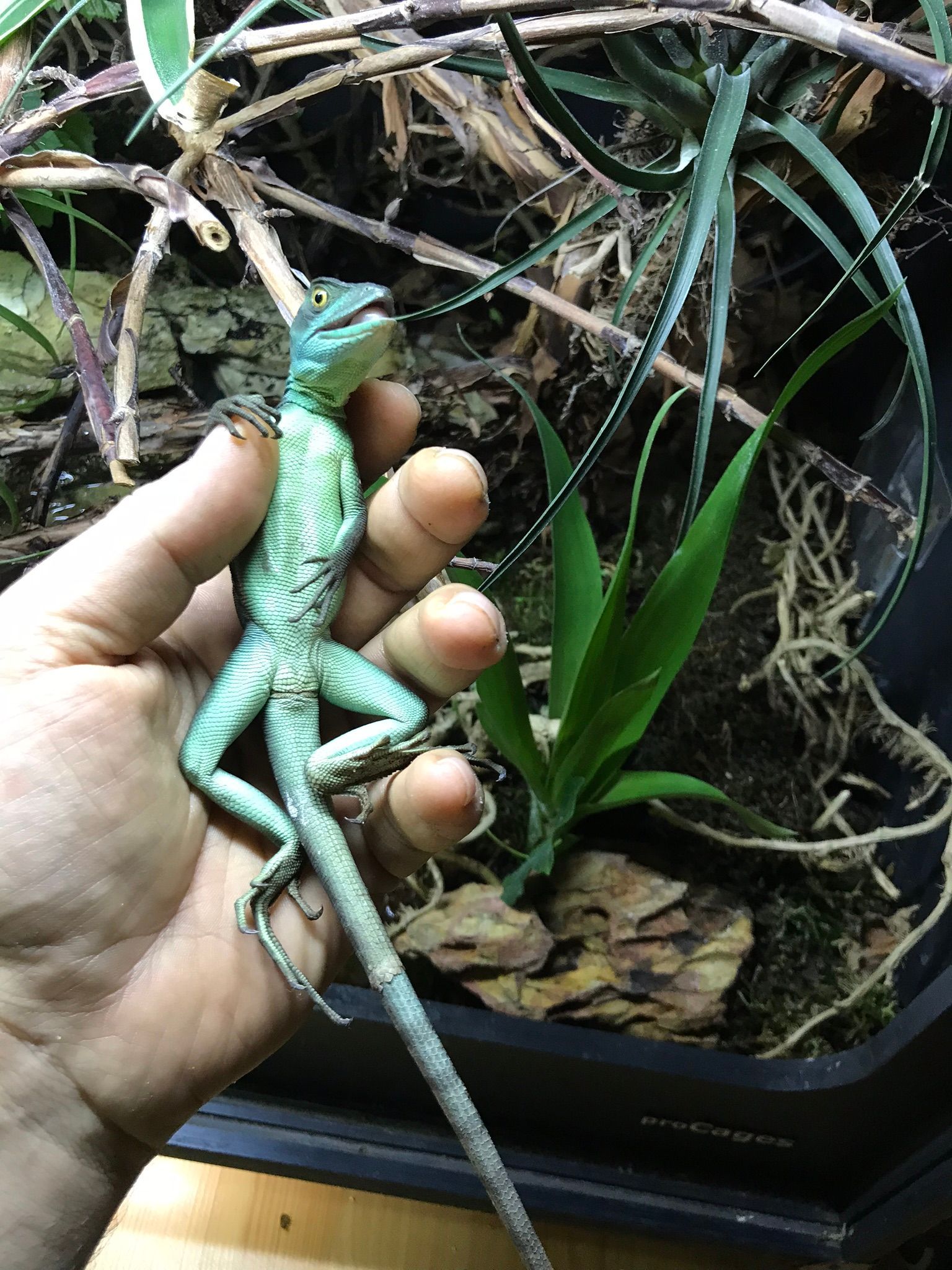
In the wild, Ahaetulla prasina feeds mainly on:
- Lizards
- Geckos
- small agamids
- occasionally frogs
This snake’s entire anatomy and hunting style are specialized for this prey.
From excellent eyesight to a slender head shape, everything is suited to a diet of slender, agile prey.
⸻
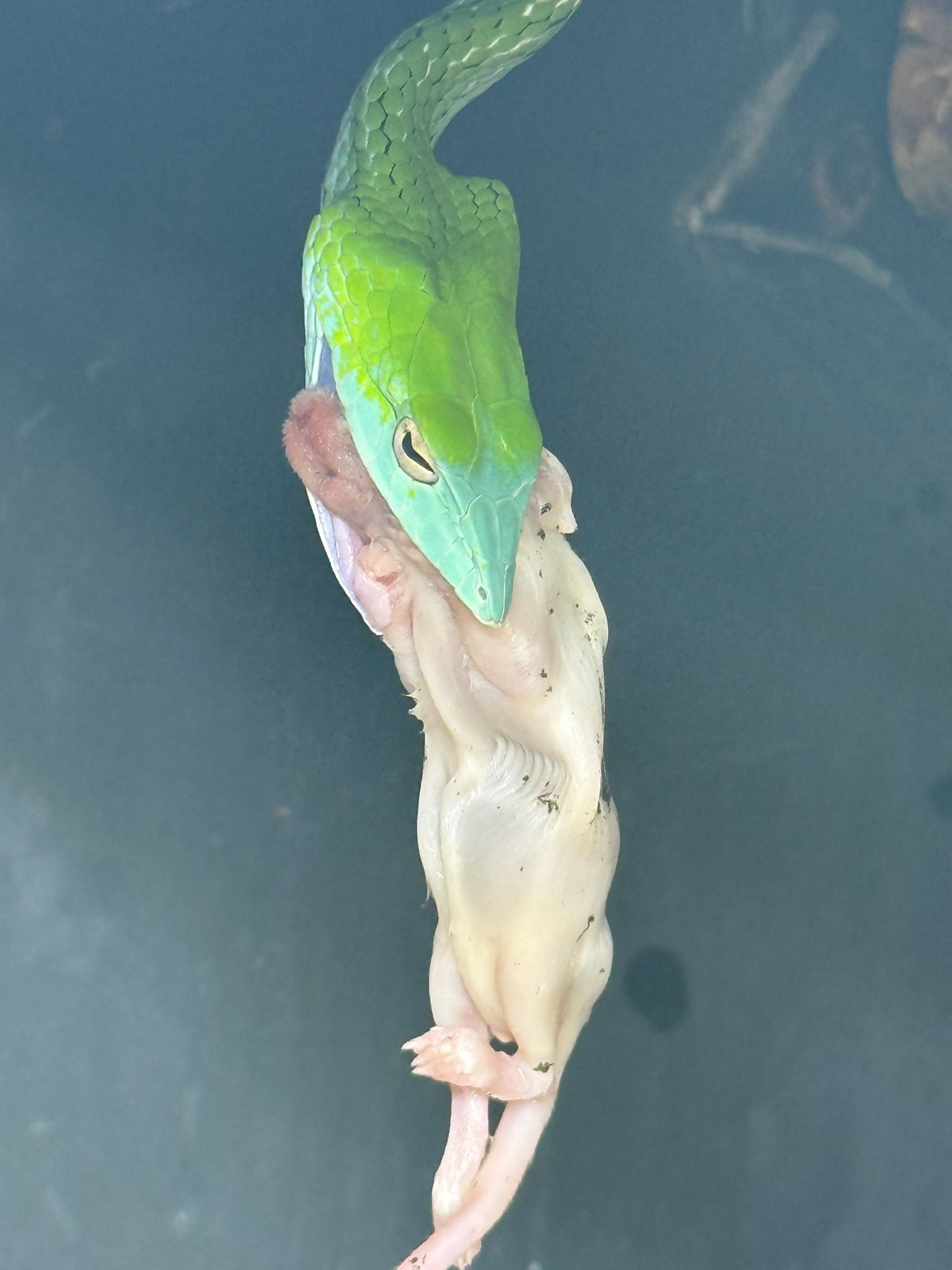
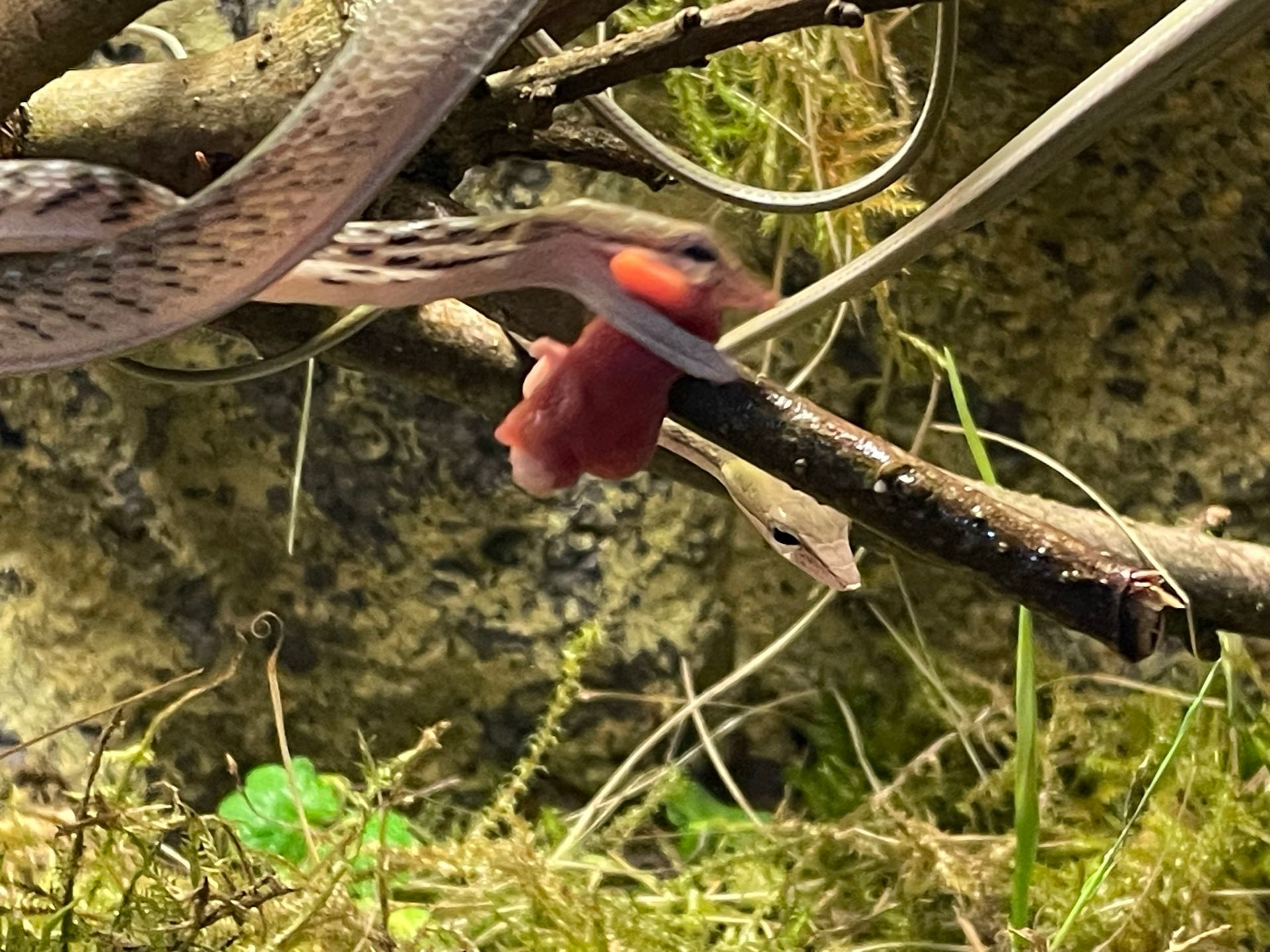
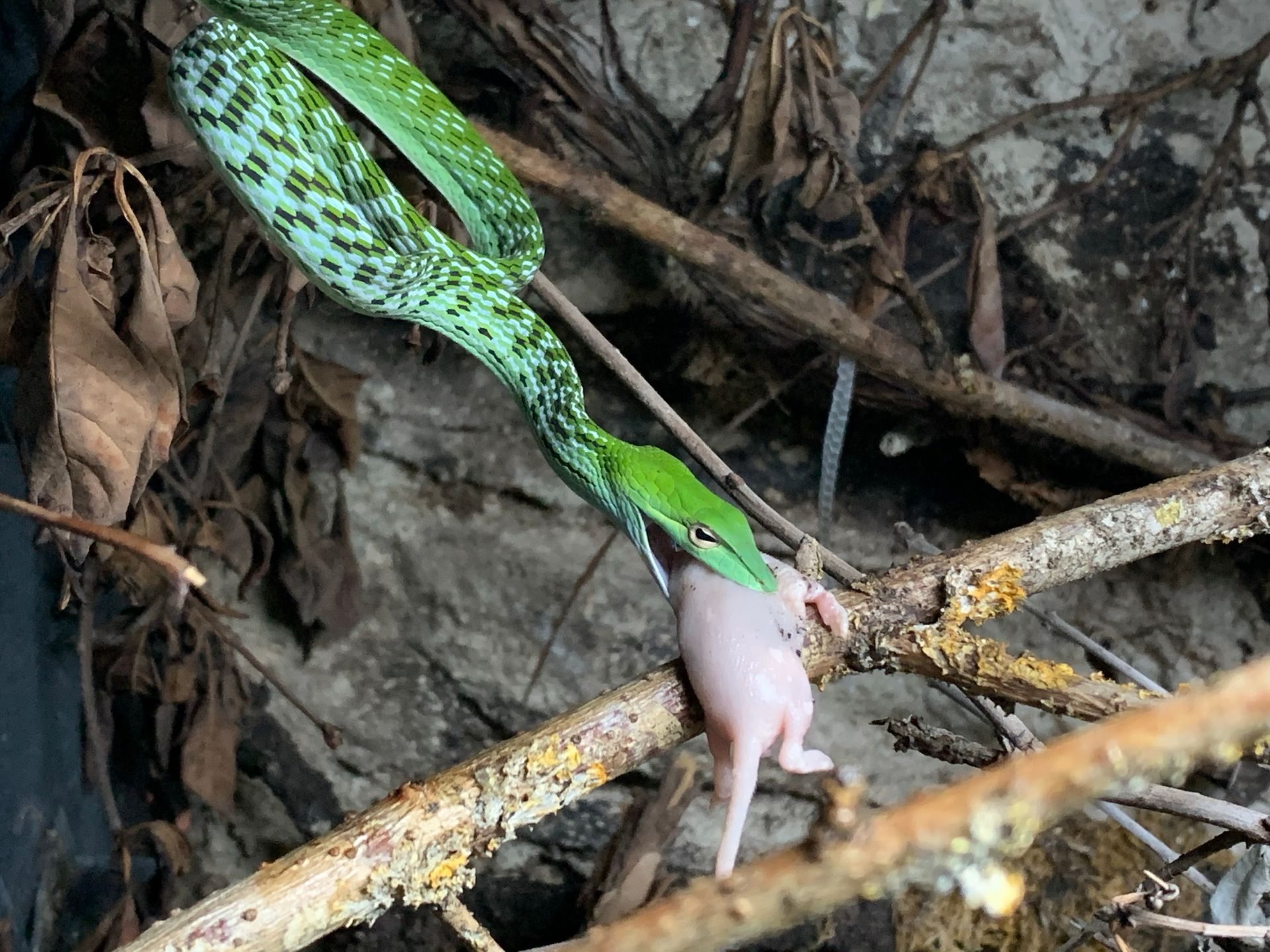
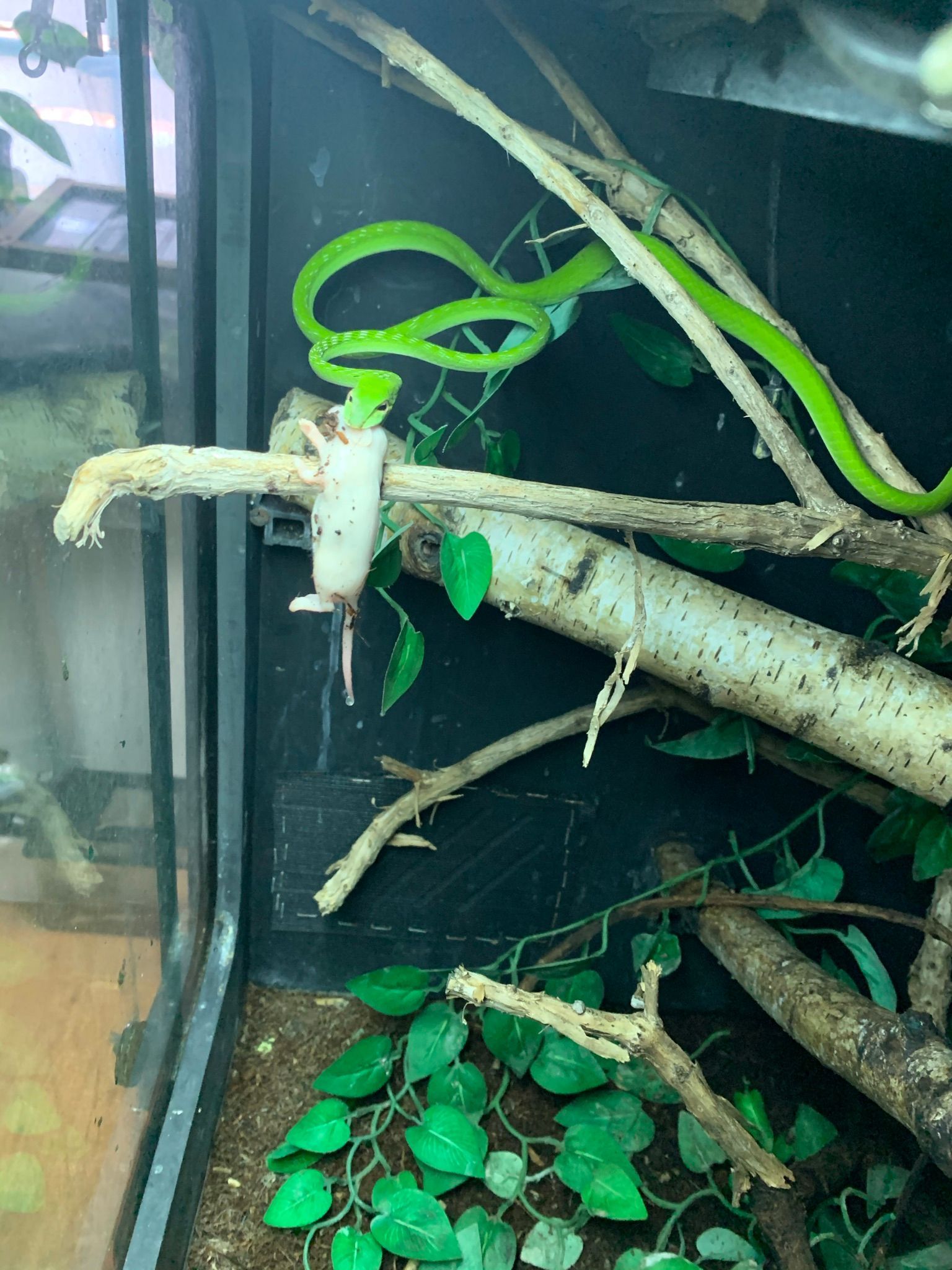
Nutritional comparison of different feeder animals
A comparison of nutrient values shows clear differences between conventional rodents and natural prey.
The differences are clear.
Lizards and frogs have:
- a higher calcium content,
- a more favourable calcium-to-phosphorus ratio,
- a higher protein content,
- and significantly less fat.
This composition is much closer to the natural diet of Ahaetulla prasina.
Species Calcium% Phosphorus% Protein % Fat %
Mouse up to 3 g. 1,17 no data 64,2 17
Mouse up to 10 g 1.47 not specified 44 30.1
Rat 1.85 not specified 57.9 23.7
Hemidactylus 5,22 2,18 no information under 10
Bearded dragon 3.53 2.35 63.6 under 10
Anolis 5,54 2,88 67,4 under 10
green frog 4.29 1.87 71.2 10.2
The differences are clear.
Lizards and frogs have:
- a higher calcium content,
- a more favourable calcium-to-phosphorus ratio,
- a higher protein content,
- and significantly less fat.
This composition is much closer to the natural diet of Ahaetulla prasina.
Why Rodents Can Be Problematic
People repeatedly try to switch lizard-eating snakes to mice or rats.
This can work for some individual animals.
Nevertheless, it is important to remember that rodents are not this species’ natural prey.
In my opinion, a permanent diet of rodents can be problematic.
Possible consequences may include:
- obesity,
- imbalanced nutrient intake,
- long-term health problems.
Even additional vitamin and mineral supplements do not automatically replace a species-appropriate diet.
Überversorgung kann ebenfalls negative Auswirkungen haben.
⸻
Personal experiments with substitute food
To avoid relying on a potentially unreliable supply, I tried various food options with my four Ahaetulla prasina.
My animals come from a range of sources and vary in age and size.
I tested:
- Fish,
- Frogs,
- earthworms,
- dead lizards,
- Rodents.
The results were disappointing.
My animals did not accept any of these alternatives long-term.
Dead lizards were not accepted either.
The prey had to be alive and moving.
⸻
The Importance of Movement
This observation is consistent with the hunting strategy of Ahaetulla prasina.
The animals hunt primarily by sight.
They respond to:
- Movement,
- Body shape,
- natural movement patterns.
Scent alone appears to play a considerably smaller role in triggering hunting behavior.
I even tried to artificially imitate movement and breathing in dead lizards.
However, it became clear that even the slightest unnatural movements tended to be disruptive.
The snake quickly focused on tools such as tweezers or a feeding tube instead of the actual prey.
A live lizard, on the other hand, is usually recognized immediately and triggers the natural hunting response.
⸻
Food Intake and Metabolism
A common misconception is that one lizard per week is sufficient.
Based on my observations, this does not appear to be the case.
Ahaetulla prasina has a relatively fast metabolism.
A suitable lizard is often digested within a few days.
I observed a male eat three house geckos (Hemidactylus) and resume actively searching for food just a few days later.
In my experience, this results in a considerably higher requirement.
⸻
My experience with feeding quantities
For an adult male, which usually remains smaller and reaches approximately 120–150 cm:
- about three to six suitable geckos per week
or alternatively:
- a few larger lizards of a suitable size
A correspondingly larger amount should be budgeted for an adult female.
Females grow significantly larger, have a sturdier build, and can handle larger prey.
The largest animal I ever caught was a basilisk about six months old.
Large females can therefore consume impressive quantities of lizards.
⸻
Feeder insect production and the realities of providing for them
Diet is where keeping Ahaetulla prasina differs significantly from keeping many other snakes.
Anyone keeping a snake like this must understand that it is not only the animal itself that needs care.
You need a complete system involving feeder animal breeding, insect production, contacts with other keepers, and reliable suppliers.
In my experience, with this species you end up becoming not only a snake keeper but also a lizard keeper.
⸻
The actual effort involved in providing food
At first glance, Ahaetulla prasina appears to be an inexpensive snake.
The purchase price is often significantly lower than that of many other specialist species.
However, the ongoing costs can paint a very different picture.
A single snake requires a large number of suitable lizards over the course of a year.
Depending on the source, the type of feeder animals and your own breeding options, annual costs can quickly reach several hundred euros.
The effort increases accordingly when keeping several animals.
⸻
My Own Experiences with Feeding Prey Items
In 2017, I needed approximately:
- 80 basilisks
- 450 Geckos
needed to care for my animals.
These figures clearly show the scale that food supply can reach.
Many keepers underestimate this point when they first start keeping lizard-eating snakes.
A snake that costs, for example, just a few dozen euros to buy may incur much higher-than-expected feeding costs over the long term.
⸻
Why breeding your own feeders becomes almost essential
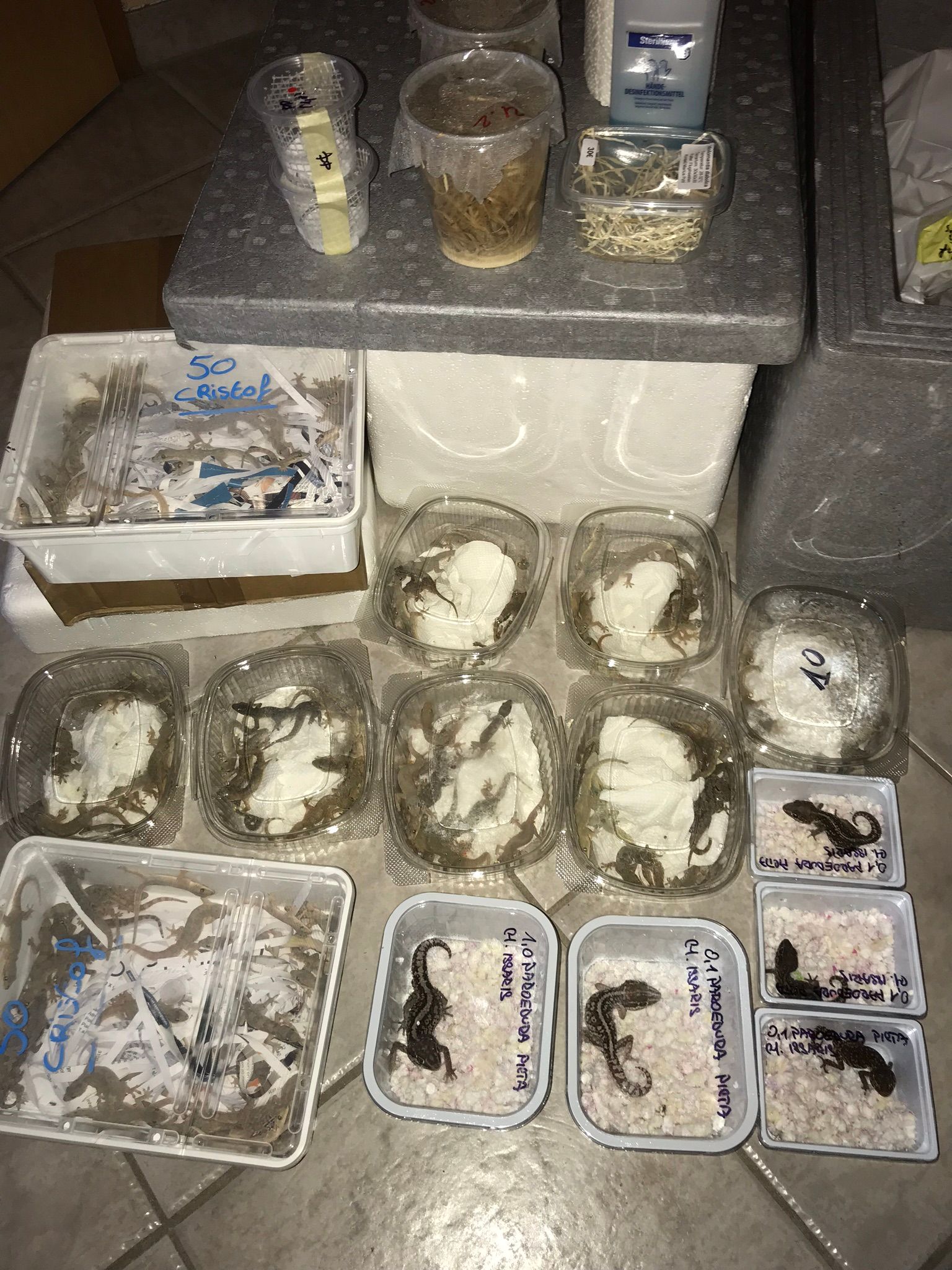
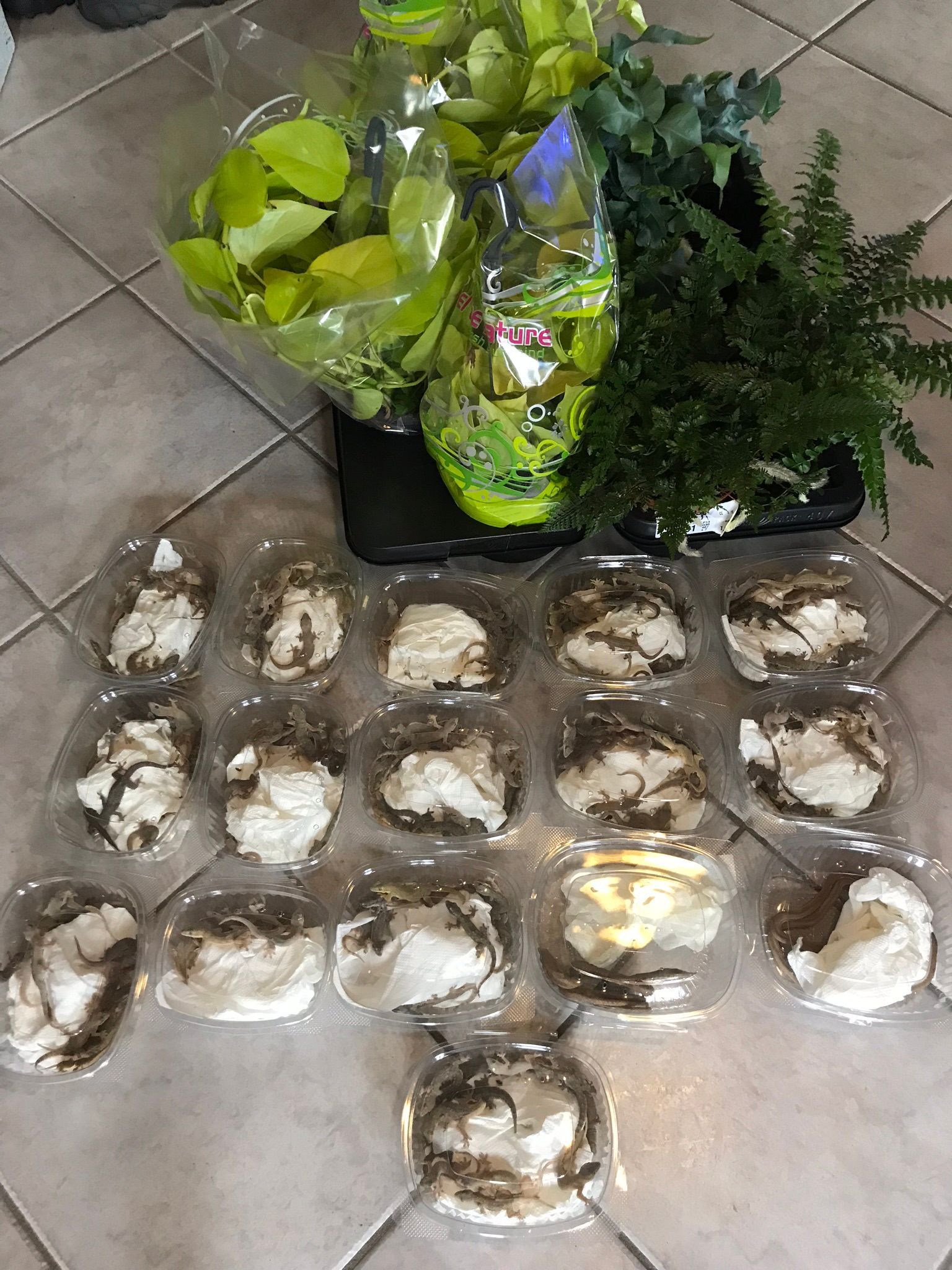
As demand for suitable lizards increases, it is becoming increasingly difficult to ensure an adequate supply of feeder animals at all times.
During my visits to the Hamm reptile expo, I noticed that more and more keepers were specifically looking for geckos and other suitable lizards.
Without reserving in advance, it can be difficult to obtain larger quantities.
In addition, availability fluctuates considerably.
Sometimes enough animals are available; sometimes there are hardly any.
For this reason, I consider breeding my own feeder animals an important addition.
⸻
Basilisks as feeder animals
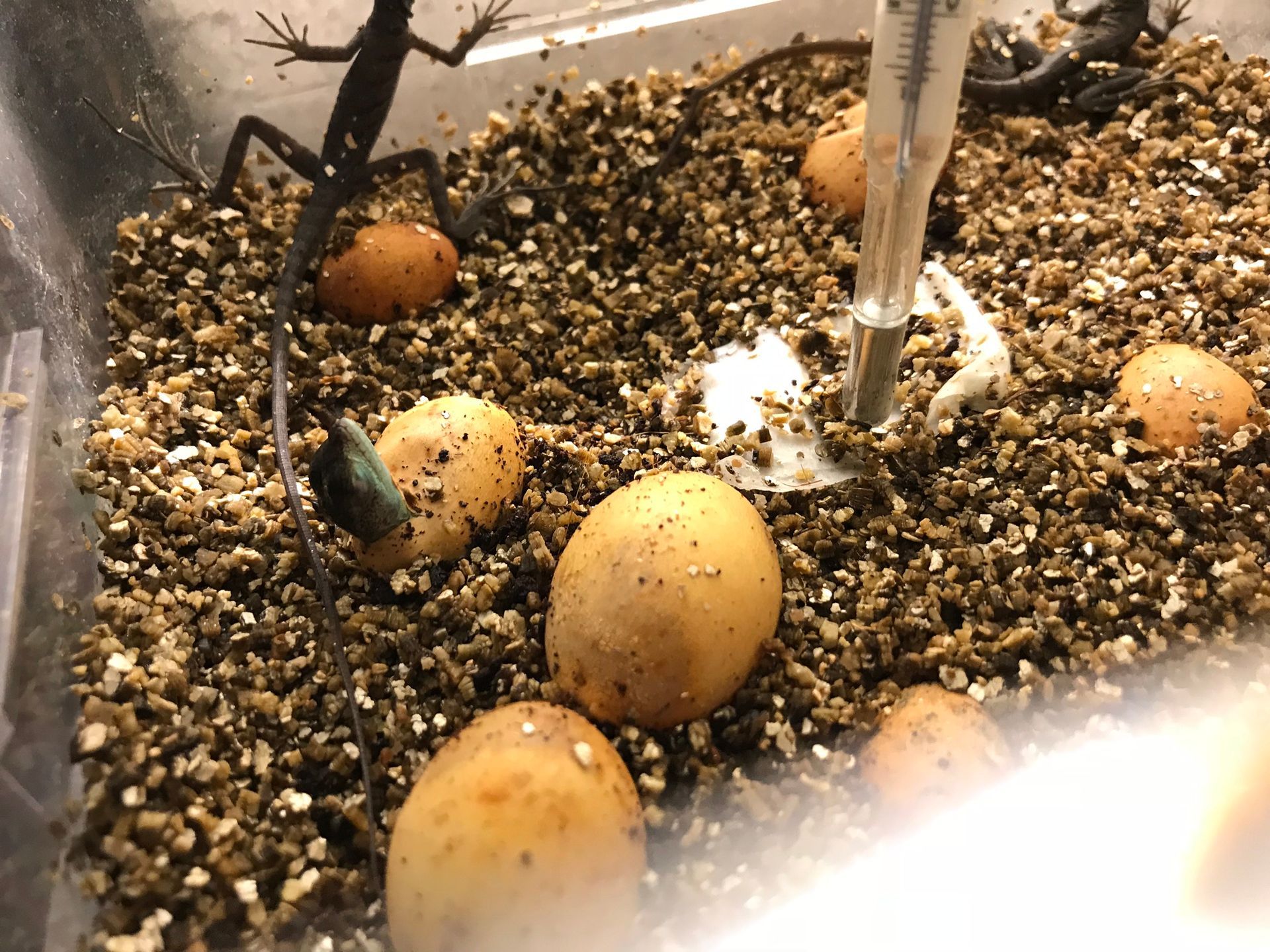
In my breeding work, I have focused in part on basilisks.
The advantage of these animals lies in their high productivity.
Under optimal conditions, a small breeding group can produce a considerable number of young.
With two breeding groups, I was able to produce around 120 offspring in good years.
Of course, there are variations here too.
A successful season does not automatically guarantee an equally successful season the following year.
⸻
Gecko breeding
Geckos also play an important role in my feeding program.
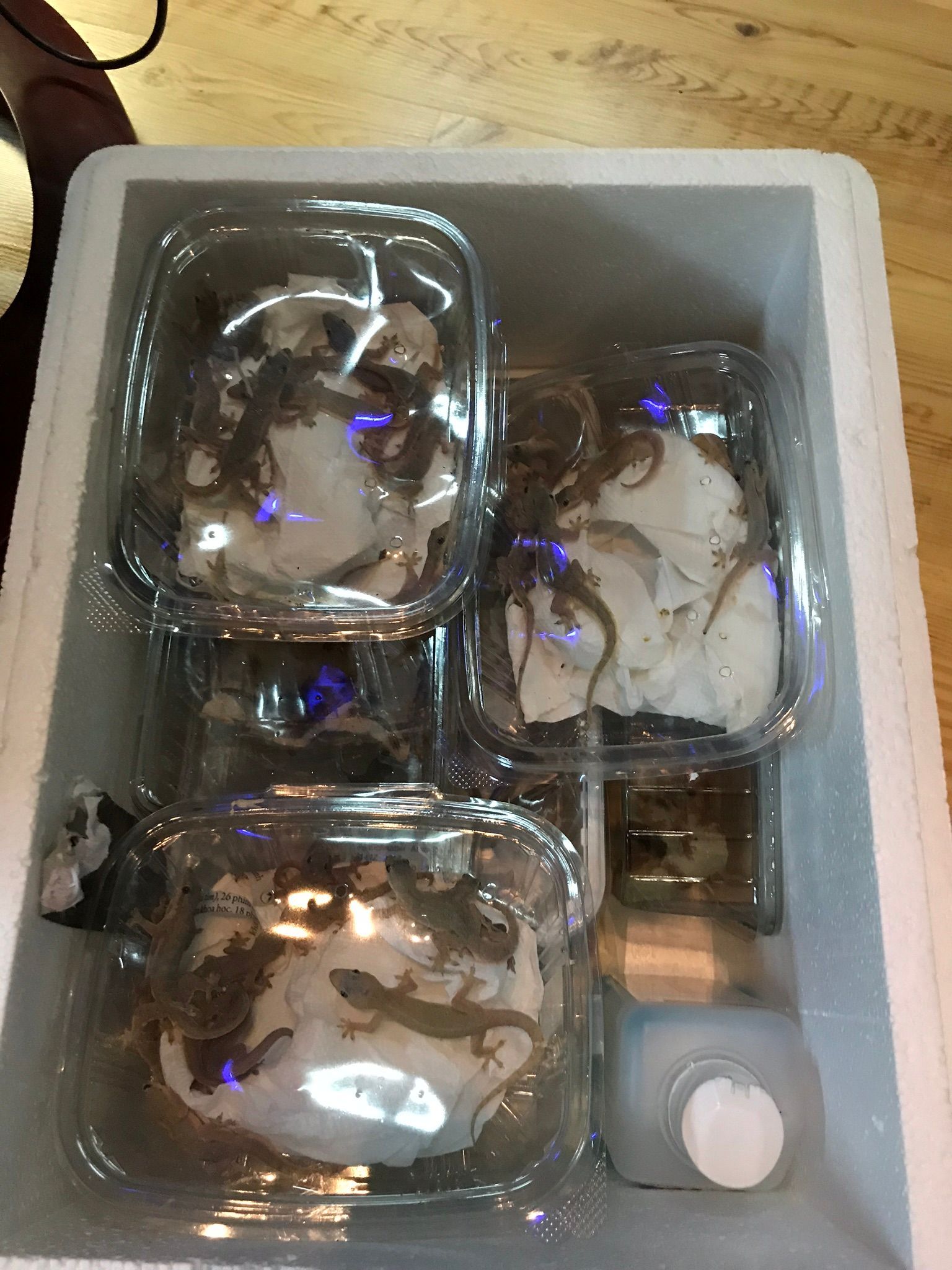
House geckos (Hemidactylus) are particularly interesting because they stay relatively small and are readily accepted by many Ahaetulla prasina.
Even so, its breeding potential should not be overestimated.
Although many geckos lay eggs regularly, this does not automatically mean a high number of viable offspring.
With several hundred geckos in my care, the actual breeding rate was significantly lower than expected.
Other gecko species often produce only a few eggs per clutch as well.
Successful feeder animal breeding therefore requires patience and experience.
⸻
You Can’t Plan Feeder Breeding
An important point is:
Even a well-established breeding programme can fail.
Temperature, humidity, illness, or simple biological fluctuations can have a significant impact.
For this reason, you should never rely on a single source.
In my opinion, reliable care is built on several pillars:
- own lizard production,
- contacts with other breeders,
- occasional purchases,
- Food storage,
- and flexible planning.
⸻
The second level: insect breeding
Anyone breeding lizards for Ahaetulla prasina automatically needs large quantities of insects.
The feeder prey chain therefore does not end with the lizard.
The lizards' diet must also be taken into account.
For example, I breed:
- Blaptica dubia (Argentine wood cockroaches)
and keep larger quantities in stock at all times.
During peak periods, with large numbers of basilisk hatchlings or several hundred geckos, even a large roach colony can reach its limits.
In addition, the following must be provided:
- House crickets,
- Mealworms,
- or other feeder insects
must be purchased.
⸻
Wild-caught geckos as a food source
A controversial topic is the use of wild-caught geckos.
Of course, removing animals from the wild is an issue that must be viewed critically.
At the same time, one should consider the reality:
Many specialized lizard-eating species remain difficult to switch to captive-bred prey in captivity.
Responsible management is essential when using wild-caught feeder animals.
These include:
- Quarantine,
- Observation,
- Hygiene,
- parasite checks,
- Removing obviously sick animals.
I keep wild-caught geckos for as long as possible before feeding them off or passing them on.
Despite every precaution, losses must be expected.
⸻
Why Keeping Them Often Fails
In my opinion, many negative experiences with Ahaetulla prasina result from unrealistic expectations.
The most common mistakes are:
- the attempt to switch the animals permanently to mice,
- zu wenig geeignetes Futter,
- lack of preparation for keeping feeder animals,
- not enough patience during the settling-in period.
An Ahaetulla should not be “tamed.”
The keeper must adapt to the animal’s needs.
⸻
Conclusion on diet
Anyone wishing to keep Ahaetulla prasina successfully should be prepared to:
- investing time in breeding feeder animals,
- to plan for space for additional terrariums,
- Building contacts with other keepers,
- to source lizards regularly,
- and to accept this species' natural diet.
The challenge is considerable—but that very specialization is what makes this snake so fascinating.
⸻
Breeding and Raising Ahaetulla prasina
Raising Ahaetulla prasina is one of the most fascinating aspects of keeping this species for me.
Although this snake is widespread throughout its natural range, there are comparatively few detailed reports of successful captive breeding.
Observations of your own are especially valuable with specialist species, as many details about their behavior, mating, gestation, and the development of their young are not yet fully documented.
From the outset, my goal was not only to keep these animals, but also to understand them as well as possible and, where possible, replicate their natural processes.
⸻
Breeding Preparation
Successful breeding begins long before the actual pairing.
The following points are essential to me:
- healthy, well-fed breeding animals,
- stable husbandry conditions,
- sufficient rest periods,
- natürliche Klimaschwankungen,
- and optimal care during the reproductive phase.
Nutritional status is particularly important in females.
Producing offspring places a considerable strain on the body. A female should therefore not be conditioned only once she is gravid, but should already have sufficient reserves beforehand.
⸻
Mating behavior
I base my breeding practices on the natural conditions of Southeast Asia.
Durch jahreszeitliche Veränderungen von Temperatur und Luftfeuchtigkeit versuche ich, die natürlichen Signale nachzuahmen, die in der Natur eine Fortpflanzung auslösen können.
After introducing a male to a female in early June, I observed the first courtship activity after about a week.
Within one month, I documented a total of five successful matings.
There were approximately four to five days between each pairing.
After that, I observed no further mating activity.
⸻
Interesting observation during the breeding season
One particularly interesting observation was that the male continued feeding normally throughout the entire breeding period.
In many snake species, males significantly reduce their food intake or stop eating altogether during the breeding season.
I have not observed this behaviour in my Ahaetulla prasina.
This again shows that every species has its own particular needs, and that you cannot automatically apply experience with other snakes.
⸻
Pregnancy and development
Ahaetulla prasina is ovoviviparous.
This means that the eggs remain inside the female’s body and develop there.
The juveniles are then born live.
During pregnancy, I was able to observe typical changes:
- increasing body girth,
- less active periods,
- Modified resting positions,
- more cautious behavior.
Unnecessary disturbance should be avoided during this time.
I consider a calm environment and stable conditions particularly important, especially for gravid females.
⸻
Birth of my offspring
I successfully bred Ahaetulla prasina for the first time in 2019.
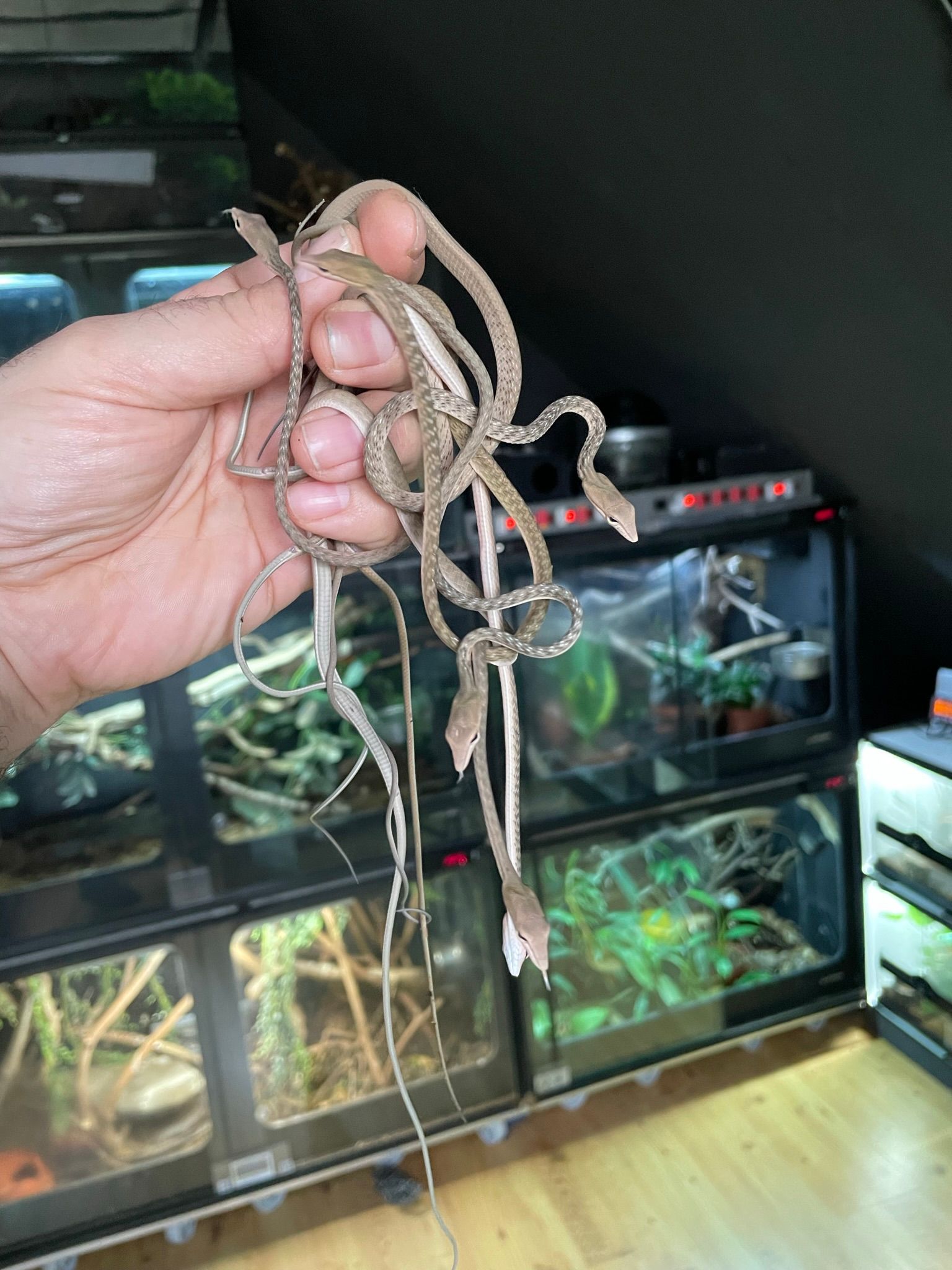
After a gestation period of approximately 172 days, the female gave birth to four healthy young.
The birth was a special moment for me.
For a species so dependent on specialized diet and husbandry, every successful breeding is an important step.
⸻
The first days of the hatchlings
Shortly after birth, the hatchlings already displayed the typical characteristics of their species.
They were:
- very active,
- excellent climbers,
- alert to movement,
- and already highly effective visual hunters.
It was fascinating to observe that many behaviors do not need to be learned.
The typical hunting strategy—slowly approaching, fixing its gaze on the prey, and striking with precision—was already clearly evident in the juveniles.
⸻
Juvenile diet
Raising juveniles requires similar care to keeping adults.
Hatchlings also remain specialized lizard-eaters.
Suitable small lizards are therefore the most important factor.
As with the adult animals, the juveniles also showed:
Prey movement is crucial.
The natural hunting response is not triggered by scent alone, but by the characteristic movement patterns of live lizards.
My juveniles already accept food before their first shed.
⸻
Growth and Development
The juveniles developed well when properly cared for.
The development of the colouration was particularly interesting.
In Ahaetulla prasina, the final coloration may not fully appear until the animal matures.
Young animals can change considerably as they develop.
Possible colour variations include:
- classic green,
- yellowish tones,
- bluish varieties,
- to various intermediate forms.
This color development is precisely what makes raising them so exciting.
⸻
The Importance of Captive-Bred Animals
Captive-bred animals hold a special place for me.
Every successful generation means:
- less reliance on wild-caught animals,
- better knowledge of the species,
- more robust animals for the terrarium hobby,
- and more experience for future keepers.
For specialist species in particular, knowledge is the most important factor.
Only when keepers share their experiences can successful husbandry of these animals continue to develop.
⸻
Personal experiences, colour variations, and my conclusion after several years with Ahaetulla prasina
After several years of keeping and breeding Ahaetulla prasina, my view of this species has changed considerably.
When I started keeping this snake in 2017, many questions remained unanswered. Much of the information about the species was contradictory, and many accounts were based either on brief keeping experience or observations of recently imported animals.
Only after observing my own animals over the long term was I able to develop a more realistic picture.
Today, I don't see Ahaetulla prasina as a “difficult snake,” but as a highly specialized species with different requirements.
⸻
The temperament of individual animals
One of the most interesting things I’ve learned while keeping this species is how much individual animals can differ.
Although all the animals belong to the same species, each one has its own personality.
Some animals are extremely shy at first:
- they flee immediately,
- hide in the vegetation,
- and are sensitive to any changes outside the terrarium.
Other animals are much calmer and get used to people more quickly.
Over time, however, I was able to notice a change in all the animals.
Many animals that were very nervous at first became much more relaxed after a few months.
In my opinion, this shows that many negative experiences with this species occur immediately after import and do not necessarily reflect the normal behavior of acclimated animals.
⸻
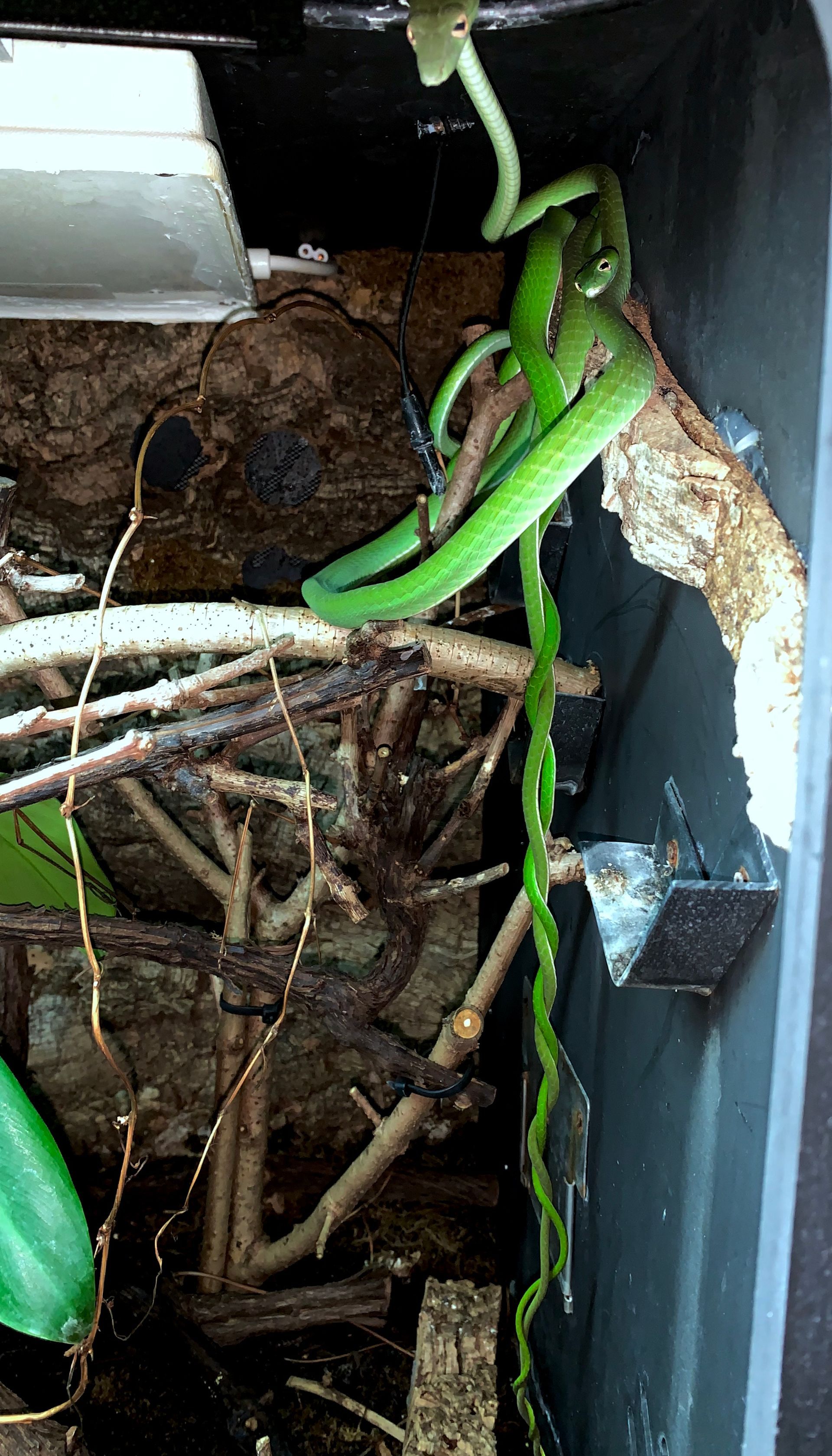
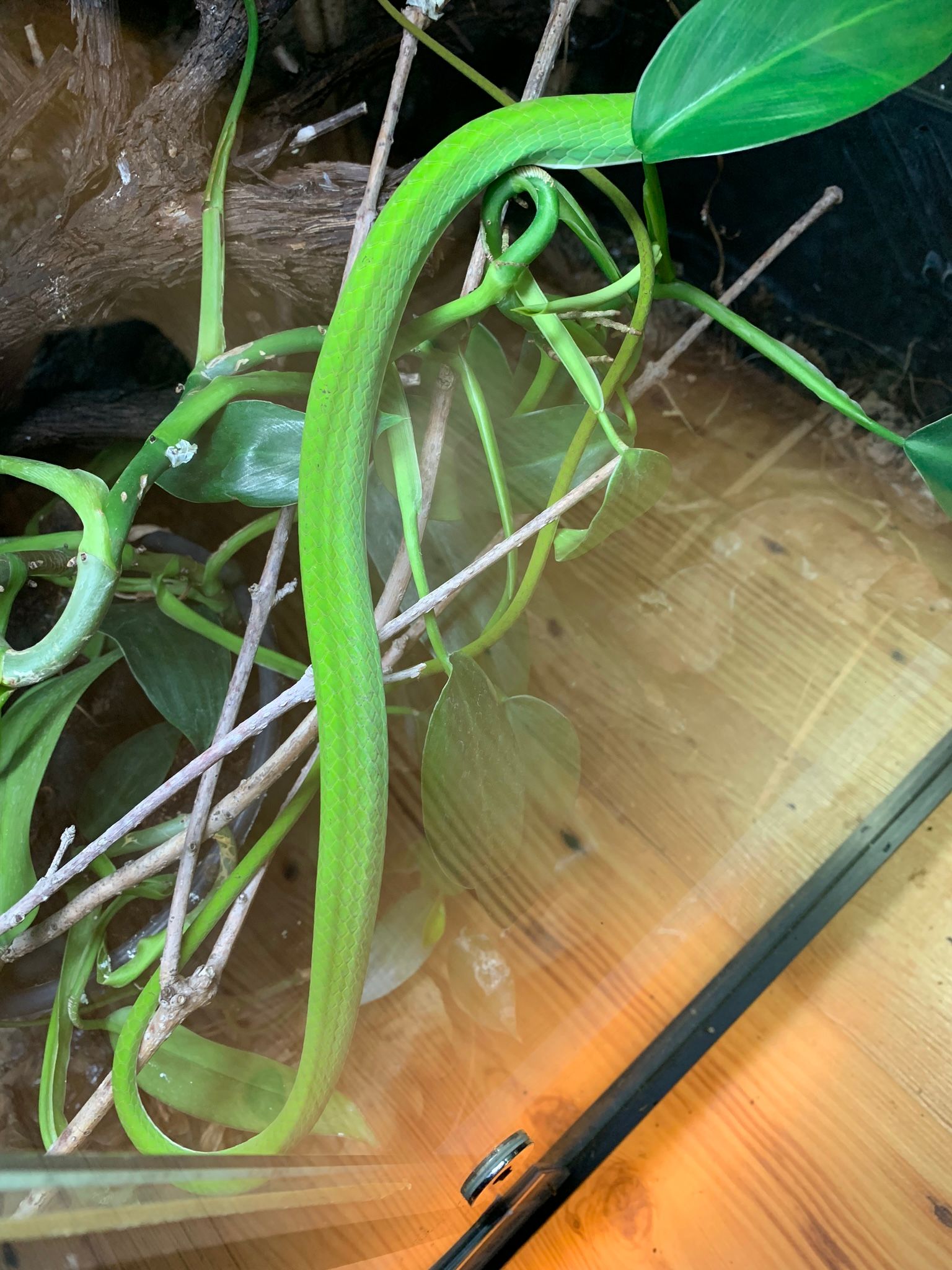
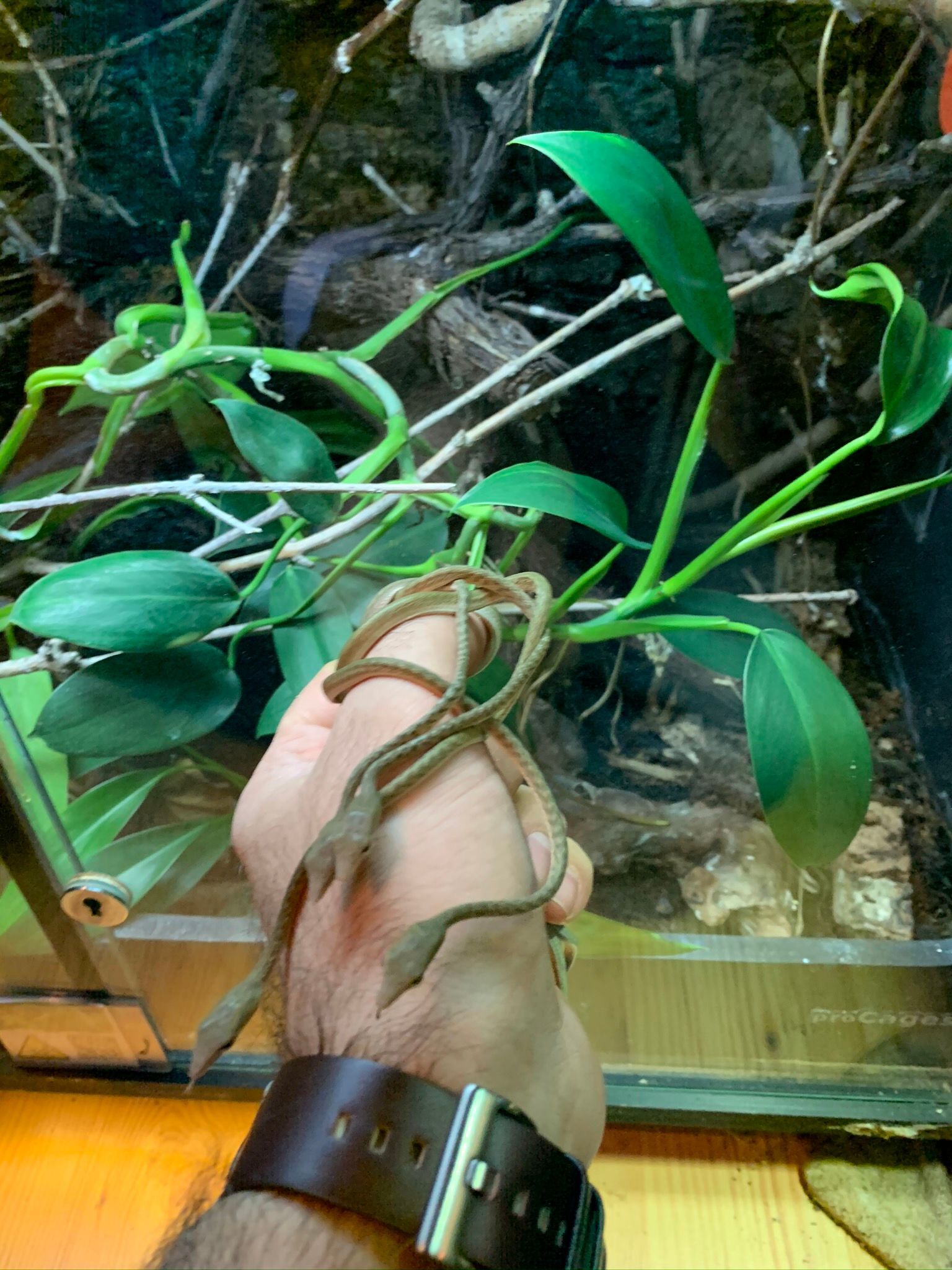
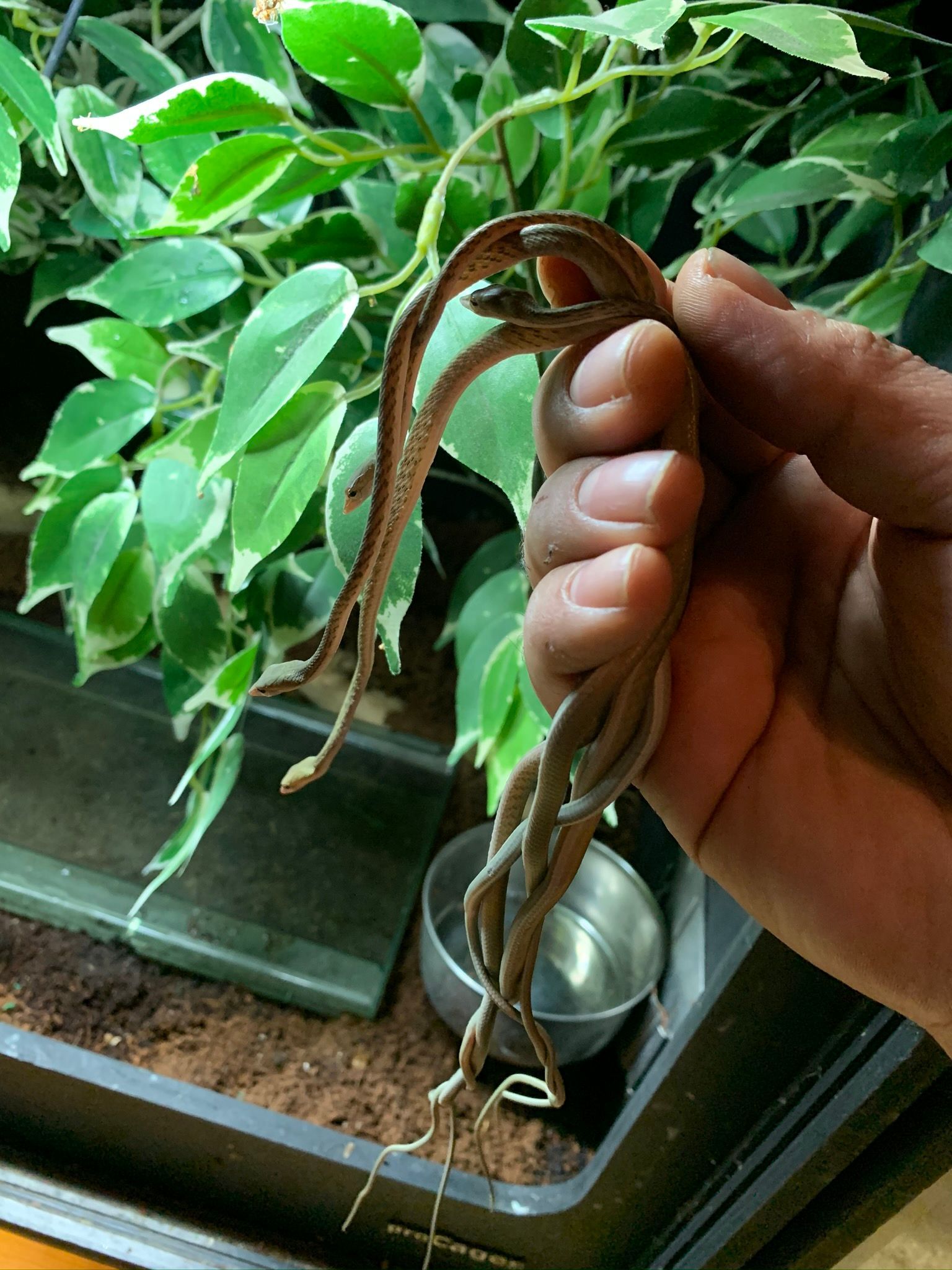
Colour variations in Ahaetulla prasina
Another fascinating aspect of this species is its extraordinary range of colours.
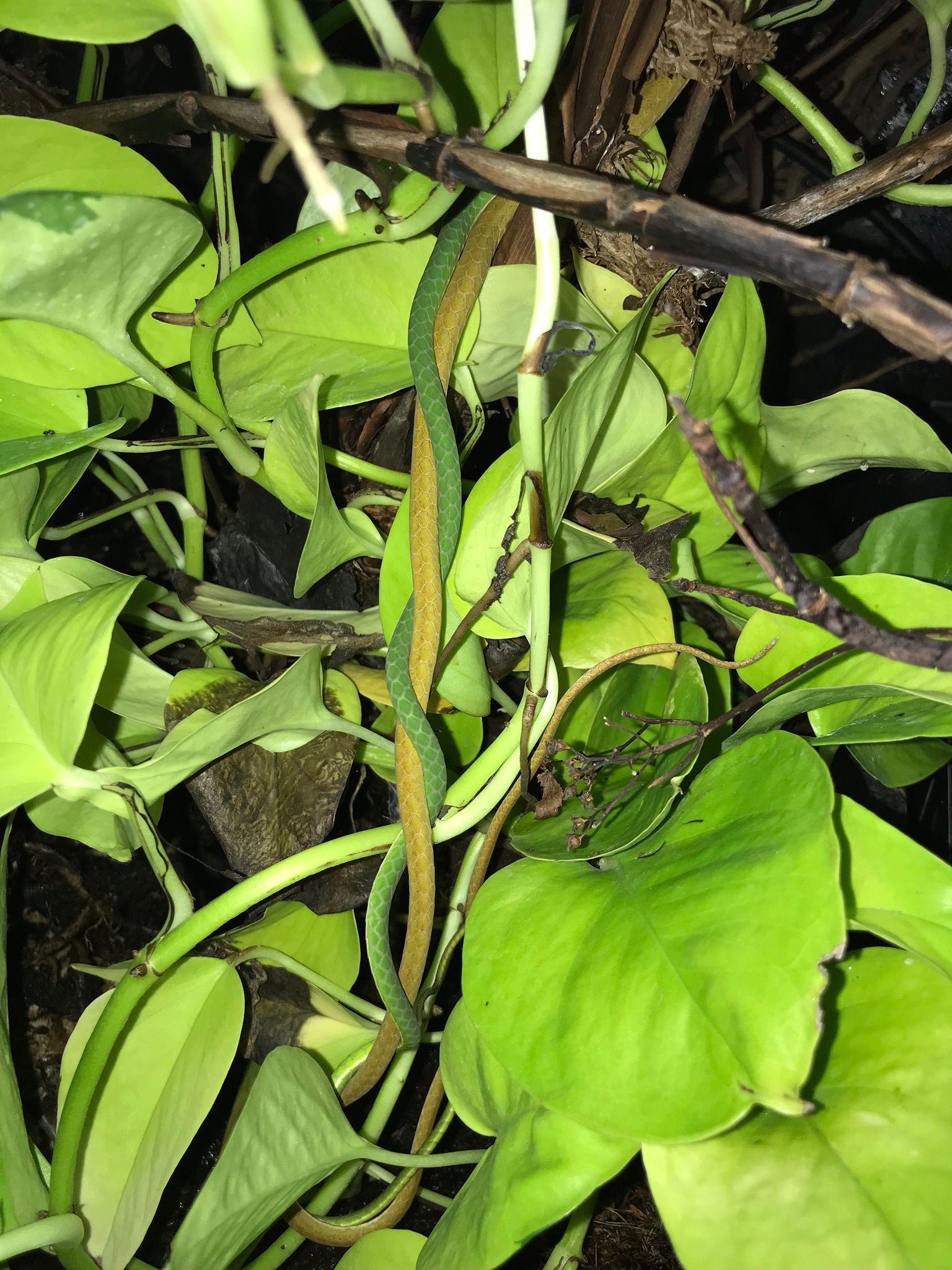
The classic image of an Ahaetulla prasina is the green vine snake—and indeed, green is the most common appearance.
However, there are numerous colour variations:
- bright green animals,
- yellowish specimens,
- turquoise-colored animals,
- bluish shimmering varieties,
- silver-coloured animals,
- Orange individuals
Significant differences can occur even within a single population.
I keep animals in yellow, blue, and nearly silver, among other colors, with coloration that stands out clearly from the typically green animals.
The final color development is particularly exciting in juveniles.
The animals can still change considerably as they grow.
⸻
Observations on Intelligence and Perception
What particularly impresses me about Ahaetulla prasina is its awareness of its surroundings.
These snakes often seem considerably more alert than many other species.
They closely track movement outside the terrarium and respond purposefully to changes.
Their exceptional eyesight can sometimes make it seem as though they are consciously analyzing their surroundings.
Of course, observations like these should not be anthropomorphized, but this species’ strong reliance on visual cues is unmistakable.
⸻
What makes this species so special
For me, the appeal of Ahaetulla prasina lies not only in its extraordinary appearance.
Many snakes have beautiful colours or interesting patterns.
Was diese Art jedoch besonders macht, ist die Kombination verschiedener Eigenschaften:
- the highly specialized body structure,
- the perfect adaptation to life in the canopy,
- the unique hunting technique,
- exceptional eyesight,
- and the challenge of feeding them.
An Ahaetulla is not a snake you can simply “own.”
You have to learn to understand them.
⸻
What I learned from this species
Keeping Ahaetulla prasina has once again shown me how important it is to respect an animal’s biology.
People often try to make animals conform to their own expectations.
However, this approach rarely works for specialist species.
The better approach is:
Rather than trying to change the snake, adjust its husbandry so it can express its natural behaviors.
This is particularly evident in their diet.
A snake that eats lizards remains a lizard-eater.
The challenge is not to get them to accept a more convenient feeder, but to provide them with their natural food.
⸻
The future of my keeping and breeding
Even after several years, there are still many aspects of Ahaetulla prasina that interest me.
My goals for the future are:
- gain more experience with captive-bred offspring,
- Document colour development,
- observe behaviour across multiple generations,
- and share knowledge about this fascinating species.
Each new observation brings new insights.
Especially with specialist reptiles, nothing can replace first-hand experience.
⸻
Final thoughts
Ahaetulla prasina is certainly not a typical beginner snake.
It requires the keeper to:
- Willingness to engage intensively,
- understanding of their specific dietary needs,
- Time for observation,
- and the willingness to go beyond normal snake-keeping practices.
However, anyone willing to meet these requirements will get one of the most fascinating snakes of all.
For me, the green vine snake is one of the most exceptional species I have had the opportunity to keep.
Not only for their beauty, but above all for their behaviour, hunting style and the challenge of keeping and breeding them successfully.
Seit 2017 begleitet mich diese Art, und auch nach Jahren entdecke ich immer wieder neue Details.
That is precisely what I find so fascinating about keeping terrarium animals:
Not just keeping animals—but truly understanding them.
⸻
Photos and videos on my profiles on the ahaetulla-prasina.com website